A Thousand Excuses for Why I Played Bad: Accountability as a Golf Skill
A golf-specific framework for understanding the excuses players make after poor rounds and converting them into useful feedback. This article introduces the Excuse Audit as a practical coaching tool for identifying patterns, reframing explanations, and building more accountable performance habits.
Steven Bradley
7/5/20264 min read
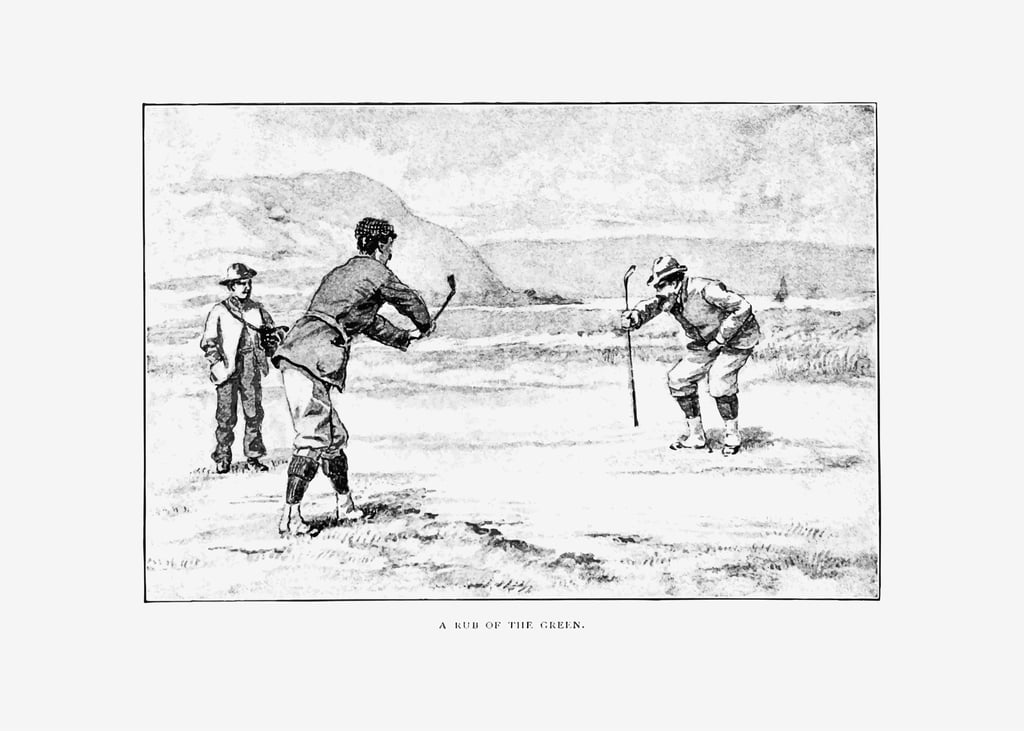
Golfers are fluent in explanation. The wind changed. The greens were slower than they looked. The lie was too tight. The group ahead disrupted the rhythm. The back tightened up on the eighth hole. The new grip never felt right. In isolation, any of these explanations may be reasonable. Golf is played in a variable environment, and no serious player should pretend that conditions are irrelevant. Yet the regularity with which golfers explain poor play through external causes deserves closer attention.
Excuse-making in golf is often humorous, but it is also psychologically meaningful. The game places unusual pressure on personal responsibility. Every shot is recorded. Every miss has a visible starting line, curve, contact pattern, distance, and consequence. Unlike team sports, golf offers few places to hide. The player is the strategist, technician, performer, and witness. When the result fails to align with the player’s self-image, the mind often seeks protection.
That protective response is consistent with self-handicapping theory. Jones and Berglas (1978) described self-handicapping as the use or reporting of obstacles that protect self-esteem when performance is poor. For golfers, the obstacle may be environmental, physical, equipment-based, or psychological. The internal message is familiar: I could have played well under different circumstances. The problem is not that the claim is always false. The problem is that, when used habitually, it prevents the golfer from identifying what must improve.
Attribution theory provides a useful coaching lens. Explanations for poor shots can be internal or external, stable or unstable, controllable or uncontrollable (Weiner, 1985). A golfer who says, “I never putt well under pressure,” may be describing a stable internal limitation that feels fixed. A more useful version would be, “My attention narrows poorly on short putts under pressure, so I need a more reliable routine.” The second statement preserves responsibility and creates a practice assignment.
This is the central coaching opportunity: the excuse should not simply be rejected; it should be translated. “The greens were too fast” becomes “I failed to calibrate speed early enough.” “I lost my swing” becomes “My ball-flight pattern changed, and I did not adjust my task.” “I got unlucky” becomes “I need to separate outcome variance from execution quality.” The language of accountability is not harsher. It is more precise.
Precision matters because golf improvement depends on feedback. Ball flight tells the truth, but the golfer must be willing to listen. A player who blames every miss on external conditions slowly trains himself to ignore evidence. A player who accepts every result as useful information becomes easier to coach and better equipped to self-correct. In this sense, accountability is not merely a moral virtue. It is a performance skill.
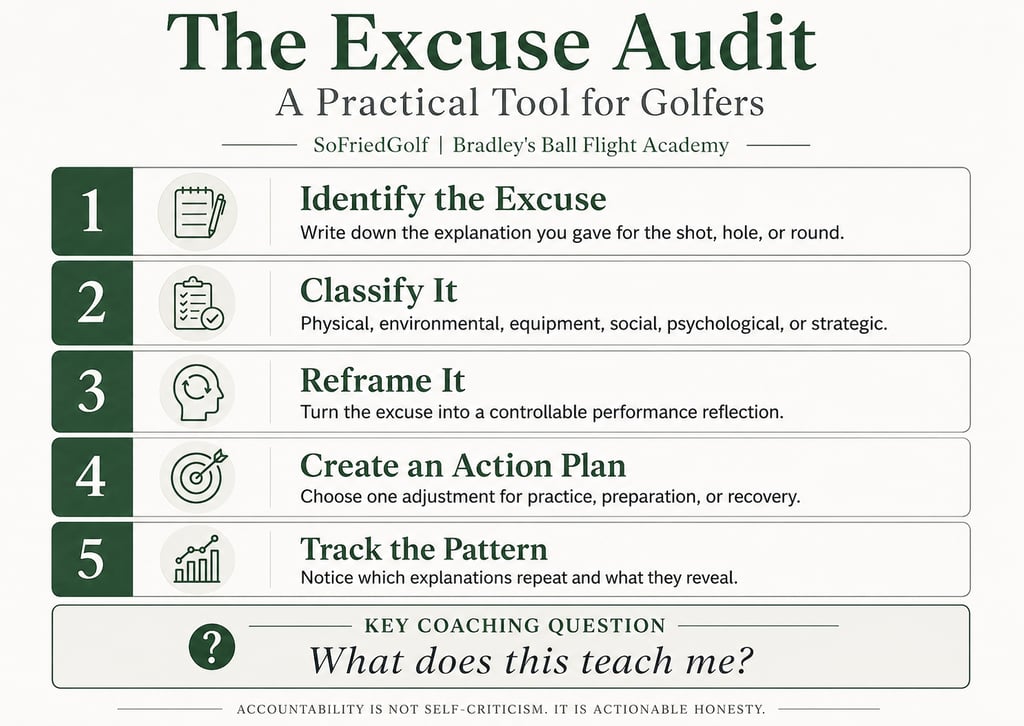
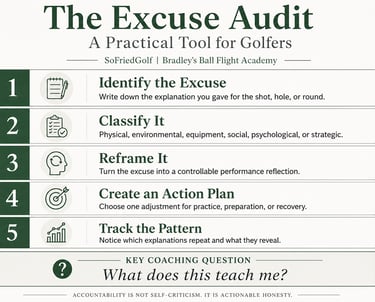
A practical way to develop that skill is through an Excuse Audit. After a practice session or round, the player writes down the most common explanations that appeared. Each explanation is then classified into one of six categories: physical, environmental, equipment-based, social, psychological, or strategic. The player then asks three questions: Was this factor real? Was it controllable? What adjustment does it suggest?
For example, “My back was tight” may be real and partially controllable. The action plan might involve a better warmup, improved recovery, mobility work, or a conversation with a qualified professional. “The wind was difficult” may also be real, but the better question is whether the player adjusted trajectory, club selection, start line, and expectations. “I always choke late” is not a useful conclusion. A more productive analysis might examine breathing, decision-making, pre-shot routine, hydration, nutrition, fatigue, and emotional regulation over the final holes.
The Excuse Audit works because it does not require the golfer to become artificially positive. Golfers do not improve by pretending bad shots are good. They improve by assigning meaning accurately. The goal is not optimism; the goal is ownership.
This distinction is especially important in coaching. A coach should not humiliate a player for making excuses, because defensiveness rarely produces learning. Instead, the coach can ask better questions. What did the ball do? What did you intend? What changed? What did you control? What would you train next? These questions move the player from storytelling to skill development.
Golf will always provide material for excuses because the game is played outdoors, over uneven ground, under changing conditions, and against a standard that no player fully masters. That is part of its appeal. However, the best players learn to separate context from avoidance. They can acknowledge wind, pressure, fatigue, and poor lies without surrendering responsibility for preparation and response.
The golfer who owns the round owns the next practice session. The golfer who owns the miss owns the correction. The golfer who owns the story owns the direction of improvement.
There may be a thousand excuses for why someone played poorly. Most are familiar, some are funny, and a few may even be true. But only one question moves the player forward: What does this teach me?
Selected References
Jones, E. E., & Berglas, S. (1978). Control of attributions about the self through self-handicapping strategies: The appeal of alcohol and the role of underachievement. Personality and Social Psychology Bulletin, 4(2), 200–206. https://doi.org/10.1177/014616727800400205
Pelz, D. (2000). Dave Pelz’s putting bible: The complete guide to mastering the green. Doubleday.
Rotella, B., & Cullen, B. (1995). Golf is not a game of perfect. Simon & Schuster.
Snyder, C. R., Higgins, R. L., & Stucky, R. J. (1983). Excuses: Masquerades in search of grace. Wiley.
Weiner, B. (1985). An attributional theory of achievement motivation and emotion. Psychological Review, 92(4), 548–573. https://doi.org/10.1037/0033-295X.92.4.548