
The Learning Illusion in Golf: Feel, Feedback, and the Work of Getting Better
A golf-specific exploration of why players often mistake familiar feels for reliable skill. This article explains how ball flight, structured feedback, and productive discomfort can help golfers move beyond compensations and become more active owners of their own improvement.
7/5/202614 min read
Introduction: The Golfer Who Knows Too Much
Golf is full of players who can explain the swing better than they can control the ball.
That is not a character flaw. It is one of the defining problems of modern golf improvement. Serious players now have access to more instruction than any previous generation: slow-motion video, launch monitors, pressure plates, social media lessons, biomechanics clips, tour-player breakdowns, podcasts, online coaching platforms, and enough terminology to turn every range session into a technical seminar.
The result is not always clarity. Often, it is a more sophisticated form of confusion.
A player may know what shallowing means without knowing whether he needs to shallow the club. He may know that face and path influence ball flight without knowing which one is driving his miss. He may know the language of ground force, sequencing, release, rotation, low point, wrist conditions, start line, dispersion, and attack angle, yet still be unable to answer the simplest question in the game: What is the ball doing, and why?
That is the learning illusion in golf.
It is the belief that information equals understanding. That a familiar feel equals a functional motion. That a swing thought that produced one good shot is a reliable solution. That a player who can describe a fault has correctly diagnosed it. That a habit reinforced over the years must be trusted because it feels natural.
Golf makes the illusion powerful because feeling is persuasive. The player feels the grip, the takeaway, the pressure shift, the top of the backswing, the strike, the finish. He feels speed. He feels control. He feels fear. He feels relief. Out of those sensations, he builds explanations.
Some are useful. Many are incomplete. Some are wrong.
The purpose of golf learning is not to reject feel. Golf cannot be played without feel. The purpose is to calibrate feel against evidence. That evidence begins with ball flight.
The ball does not care how the swing felt. It does not care whether the player liked the move, trusted the thought, copied the model, or believed the explanation. The ball responds to impact. It is not the whole story, but it is the honest starting point.
If Bradley’s Ball Flight Academy is built on one premise, it is this: the ball flight tells the truth before the golfer does.
I. The Difference Between Feel and Evidence
Golfers are gifted storytellers after bad shots.
“I came over it.”
“I lifted up.”
“I got quick.”
“I didn’t turn.”
“I held the face open.”
“I decelerated.”
“I peeked.”
Sometimes those explanations are correct. More often, they are post-shot narratives. The player feels disappointed by the result and reaches for a familiar cause. The explanation gives the miss a name, and naming the miss feels like understanding it.
But a named miss is not necessarily a diagnosed miss.
A topped shot may not be caused by “looking up.” A slice may not be solved by telling the player to swing more to the right. A pull with a wedge may not be a tempo problem. A missed putt may not be a stroke problem. Golfers often treat the felt symptom as the cause, then practice the wrong solution with great commitment.
Daniel Kahneman’s work on cognitive illusion helps explain why this happens. In Thinking, Fast and Slow, he describes the mind’s tendency to build coherent stories from limited information. One of his useful phrases is WYSIATI: “What You See Is All There Is.” The mind forms a story from what is available and often behaves as if missing information does not matter.
Golfers do this constantly. They feel a swing, see a ball flight, remember a recent lesson, and produce a tidy explanation. The explanation may be coherent. That does not make it true.
Dave Pelz’s putting research provides a concrete example in golf. Pelz found that golfers routinely under-read break, often by several times the actual amount required. The player sees the putt, makes a read, misses low, and may blame the stroke. The ball has offered evidence, but the player’s interpretation protects the original belief. Even after watching the ball roll, golfers often fail to adjust their perception enough.
This is the learning illusion in miniature. The golfer believes he is responding rationally to the evidence while continuing to misread it.
The coach’s job is to interrupt that loop.
II. Harvey Penick and the Problem of the Hands
Few parts of golf reveal the learning illusion more clearly than the grip.
The grip is the player’s only physical connection to the club, yet many golfers treat it as too basic to revisit or too personal to challenge. A player may accept advice about shoulder turn, takeaway, hip rotation, transition, tempo, or finish long before he accepts that his hands may be corrupting the whole system.
Harvey Penick understood the problem. His warning was blunt: “If you have a bad grip, you don’t want a good swing.” That is more than a clever line. It is a systems diagnosis. A poor grip can force the rest of the motion to compensate. The player may alter the path to manage face. He may change the release to manage the start line. He may adjust posture, ball position, or tempo to make the impact playable.
Over time, the compensation becomes familiar. Then the familiar compensation begins to feel like a skill.
This is why grip changes are so emotionally difficult. Penick knew that changing a bad grip requires practice and patience because the corrected grip often feels wrong before it works. That is the cruel part. The old grip feels correct because it has history. The new grip feels incorrect because it lacks familiarity. The golfer’s body votes for the old pattern even when the ball flight has been arguing against it for years.
Ben Hogan’s language was equally direct. In Five Lessons, Hogan treated the grip as foundational, famously writing that “good golf begins with a good grip.” Jack Nicklaus, in Golf My Way, emphasized the hands as the player’s essential linkage to the club. These are not minor details. They are reminders that the golf swing is not a collection of independent parts. It is a system, and the hands influence the entire system before the club ever moves.
This does not mean every golfer needs the same grip. Golf has always allowed functional individuality. But individuality is not the same as disorder. A grip does not need to look identical from player to player; it needs to help the player deliver the club in a way that produces playable ball flight.
The question is not: Does the grip look textbook?
The question is: What does this grip make possible, and what does it force the golfer to compensate for?
III. Why Better Often Feels Worse First
Fitts and Posner’s stages of motor learning help explain why golfers resist necessary changes. A player first learns consciously, then refines through practice, and eventually performs with increasing automaticity. A longtime golfer may have reached the autonomous stage with a flawed pattern. The pattern is not ideal, but it is familiar, fast, and available.
When a coach changes something foundational, the player may be pushed back into conscious learning. The grip feels strange. The clubface feels lost. The strike may get worse. The player who walked onto the lesson tee feeling competent suddenly feels like a beginner.
That experience is not pleasant. It is also not automatically a sign that the work is wrong.
The player may be experiencing the cost of reopening a movement pattern that had become automatic around a flawed solution. In other words, the player is not losing skill. He is losing immediate access to an old compensation.
This distinction matters because golfers often abandon good work too soon. They try a grip change for fifteen balls, dislike the feel, hit two poor shots, and return to the old pattern. The old pattern feels better immediately because it is known. The player calls this “trusting feel,” but sometimes it is simply retreating to the familiar.
Robert and Elizabeth Bjork’s concept of desirable difficulties belongs here. Learning that lasts often feels less fluent while it is happening. The practice may be harder, slower, and less satisfying in the short term because it requires the learner to build a more durable pattern. Brown, Roediger, and McDaniel make a similar case in Make It Stick: easy learning can be deceptive, while effortful learning often produces better retention and transfer.
The golfer does not need difficulty for its own sake. Bad instruction can be difficult. Confusing drills can be difficult. Poorly explained changes can be difficult. The point is not to romanticize struggle.
The point is to distinguish productive discomfort from unproductive confusion.
Productive discomfort has a clear reason. The player understands what is being changed, why it matters, what evidence will be used, and the short-term cost. Unproductive confusion leaves the player with too many thoughts, too little feedback, and no way to gauge progress.
Good coaching makes the discomfort intelligible.
IV. Geoff Ogilvy, Scottie Scheffler, and System Integrity
Geoff Ogilvy’s observation about Scottie Scheffler is useful because it brings the discussion out of theory and back to elite practice. Scheffler’s footwork is famously unconventional. His swing does not invite simple textbook language. Yet Ogilvy noted that Scheffler uses a grip guide and pays close attention to the one connection that matters before every swing begins.
Ogilvy’s conclusion is the kind of sentence that could sit above every serious lesson tee: “All that really matters is what the ball does.”
That does not mean appearance is irrelevant. Nor does it mean mechanics do not matter. Mechanics matter because they influence what the ball does. The problem begins when the coach or player becomes more loyal to a model than to the evidence.
Scheffler is a useful example precisely because he complicates cosmetic instruction. If a coach were judged only by appearances, there would be plenty to question. But the ball flight answers more honestly than the still frame. The player’s system works because the pieces that matter most for his performance are stable enough to produce elite control.
This is the principle golfers often miss. The point of instruction is not to make a swing look normal. It is to build a system that produces better shots, better decisions, and more reliable patterns.
A grip guide, in that context, is not remedial. It is system integrity. It reduces uncertainty. It keeps the foundation from drifting. It allows the player to preserve individuality without sacrificing the fundamental relationship between the hands, the clubface, and ball flight.
That is the difference between style and function.
V. Michael Bamberger and the Danger of Losing the Line
In To the Linksland, Michael Bamberger includes a teacher’s lament about golf instruction becoming too fragmented. The teacher says instructors learned to see the “points” but “lost track of the line.”
That distinction is one of the best ways to understand modern golf confusion.
Golf instruction often breaks the swing into parts: grip, stance, posture, takeaway, top, transition, downswing, impact, release, and finish. This can be useful. Coaches need to identify parts. Players sometimes need to train parts. But the golfer does not play golf as a sequence of still frames. The golfer experiences the swing as motion, intention, rhythm, and response.
The points matter only if they serve the line.
A player can become so focused on positions that he stops playing the shot. He manages the backswing instead of sending the ball. He monitors the wrist instead of committing to the target. He thinks about the shape of the motion rather than the demand of the shot. The result is not better learning. It is mechanical self-surveillance.
This is the same problem seen in performance psychology. Masters and Maxwell’s theory of reinvestment describes how performers under pressure may bring conscious control back into skills that should run more automatically. The player begins monitoring mechanics and loses freedom. What appears to be carefulness becomes interference.
The golf lesson, then, must avoid two failures. It cannot ignore the points, because fundamentals matter. But it cannot worship the points, because golf is played as a line.
The coach’s task is to know when to isolate and when to integrate.
VI. From Teacher-Centered Instruction to Guided Discovery
Golf instruction has often leaned heavily toward teacher-centered correction. The coach diagnoses. The coach explains. The coach demonstrates. The player attempts to comply.
That approach has a place. A beginner may need direct instruction in grip, aim, setup, and basic contact. A player with a foundational error may need the coach to intervene clearly. There is nothing noble about leaving a novice to discover a poor pattern for six months. Structure matters.
But teacher-centered instruction becomes limiting when it produces dependence. The golfer learns to wait for correction. The coach becomes the player’s permanent interpreter. The player may improve during lessons but remain unable to practice effectively alone or adjust on the course.
Learner-centered instruction offers the necessary correction, but it also carries its own risks. Too much freedom without enough structure can become aimless exploration. A player who does not yet know what to notice may reinforce the wrong pattern.
The better model is guided discovery.
Guided discovery allows the coach to design the environment while requiring the player to participate in the solution. Instead of telling the player every body movement, the coach may set a task, create a constraint, ask a question, or use ball flight to guide awareness. The player is not abandoned. But the player is not treated as a robot either.
A coach working on clubface awareness might ask the player to start three balls right of a target, then three left, then three through a narrow window. A coach working on a low point might draw a line on the ground and ask the player to brush the turf forward of the line. A coach working on putting might ask the player to predict break, roll the putt, observe the miss, and adjust the read before touching the stroke.
These are not gimmicks. They are learning designs.
The player is being taught to connect intention, motion, feedback, and result. That is golf learning.
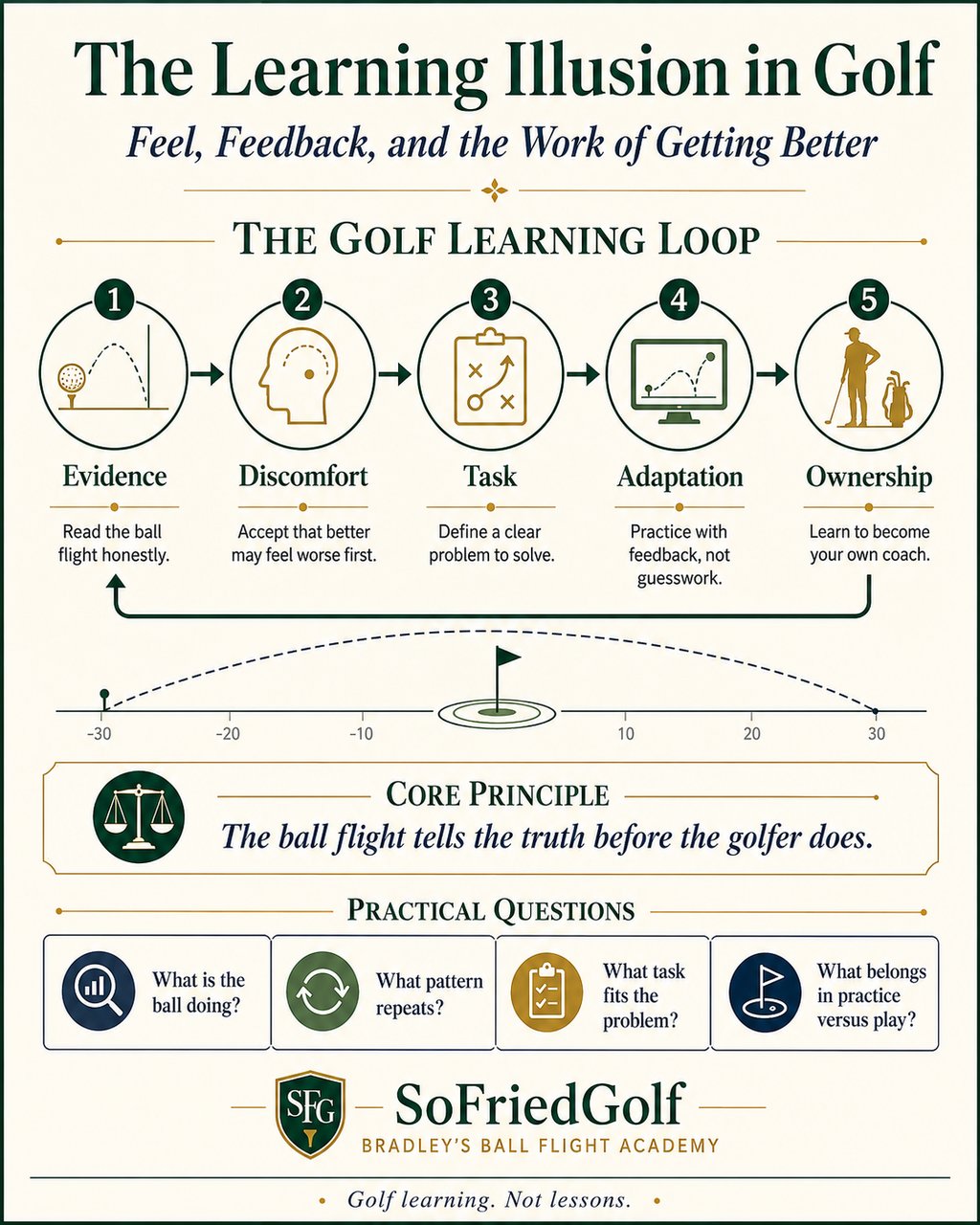
VII. The Golf Learning Loop
The difference between taking lessons and learning golf is what happens after the explanation.
A lesson can provide information. Learning requires a loop.
The practical model is:
Evidence. Discomfort. Task. Adaptation. Ownership.
1. Evidence
The process begins with what the ball is doing. Where does it start? How does it curve? Where is contact? What is the strike pattern? What happens under pressure? What repeats across clubs, lies, targets, and situations?
Evidence protects the player from guessing and protects the coach from teaching a theory instead of the golfer in front of him.
2. Discomfort
Once evidence challenges the player’s familiar explanation, discomfort usually follows. The golfer may realize that a trusted feel is misleading, that an old grip is forcing compensation, or that the favorite swing thought is only a temporary patch.
This discomfort must be handled carefully. The player should not panic, and the coach should not dismiss the player’s experience. The feeling is real. It just may not be reliable.
3. Task
A task turns information into practice.
Start the ball right of the target. Curve it less. Strike the ground forward of the line. Launch the wedge lower. Roll the putt over the spot. Hit three shots that finish left of the flag without curving left. Land five chips inside a defined zone.
The task gives the golfer a problem to solve rather than a lecture to remember.
4. Adaptation
The player then practices with feedback. This is not mindless repetition. It is testing. The golfer observes, adjusts, and repeats. Some attempts fail. Some reveal. Some produce partial success. Over time, feel becomes calibrated against outcome.
This is where learning becomes durable.
5. Ownership
The final stage is ownership. The player begins recognizing patterns without needing constant external diagnosis. He can distinguish between a poor decision and a poor swing, between a random miss and a recurring tendency, between a feel that helps and a feel that merely comforts.
Ownership does not mean the golfer no longer needs coaching. It means the golfer is no longer passive.
That is the purpose of “Golf learning. Not lessons.”
VIII. The Range, the Course, and the Right Time to Think
A related illusion is that every golf problem should be solved during play.
The range is where technical exploration belongs. That is where a player can test a grip, change a setup, exaggerate a movement, use feedback tools, rehearse a pattern, and tolerate awkwardness. The course is different. The course requires the player to use the game that showed up that day.
This does not mean mechanics disappear from the course. It means mechanics need a home. The player should not conduct a lesson over the ball.
The useful question during play is not, “What is wrong with my swing?”
The useful question is, “What does this shot require?”
That question moves attention outward. It asks the golfer to consider target, lie, wind, trajectory, club, start line, and acceptable miss. It turns the player from a self-monitoring mechanic into a performer solving a task.
After the shot, the player can review. Was the decision good? Was the commitment clear? Did the ball match the intended start line, curve, contact, and distance? What pattern is emerging? What belongs in practice later?
This is how thinking becomes ordered rather than excessive.
Think before the shot. Commit during the shot. Learn after the shot.
IX. Becoming Your Own Coach
The highest purpose of golf instruction is not dependence.
A good coach helps the golfer become a better observer, practicer, decision-maker, and interpreter of feedback. The player should leave the learning environment with more than a swing thought. He should leave with a clearer understanding of how to work.
That means learning better questions:
What is the ball doing repeatedly?
Is this a face problem, a path problem, a contact problem, a speed problem, a decision problem, or a commitment problem?
What is the simplest task that addresses the pattern?
What feedback will tell me whether the task is working?
Am I practicing the skill I need, or rehearsing what already feels good?
Is this discomfort productive, or am I confused?
What belongs on the range, and what belongs on the course?
These questions make golf more playable by reducing panic. The golfer who can classify problems does not have to turn every miss into a swing crisis. He can understand that some errors are technical, some are strategic, some are attentional, and some are simply part of the game.
The learning illusion makes every shot a referendum on identity.
Golf learning makes every shot information.
Conclusion: The Ball Is Already Teaching
Golf is not learned through information alone. It is learned through the disciplined relationship among intention, motion, evidence, feedback, and adaptation.
The learning illusion tells golfers that because something feels familiar, it must be right. Because they can explain a miss, they must understand it. Because a change feels strange, it must be wrong. Because they have practiced a pattern for years, it must be part of who they are.
The ball challenges those assumptions.
It shows what impact it produced. It does not flatter. It does not care about theories. It does not protect old feels. It simply reports.
Good coaching helps the player read that report. It organizes difficulty, protects the learner from noise, provides structure when needed, creates autonomy when possible, and teaches the golfer to connect feel with evidence. It does not turn every miss into a rebuild or every lesson into a lecture. It asks the player to become an active participant in his own improvement.
That is the work of getting better.
Not collecting tips.
Not chasing comfort.
Not defending old feels.
Learning.
The ball is already giving the lesson. The serious golfer learns how to listen.
Selected References
Bamberger, M. (1992). To the Linksland. Viking.
Beilock, S. L., & Carr, T. H. (2001). On the fragility of skilled performance: What governs choking under pressure? Journal of Experimental Psychology: Applied, 7(2), 71–81.
Bjork, R. A., & Bjork, E. L. (2011). Making things hard on yourself, but in a good way: Creating desirable difficulties to enhance learning. In M. A. Gernsbacher, R. W. Pew, L. M. Hough, & J. R. Pomerantz (Eds.), Psychology and the real world: Essays illustrating fundamental contributions to society. Worth Publishers.
Broadie, M. (2014). Every shot counts: Using the revolutionary strokes gained approach to improve your golf performance and strategy. Gotham Books.
Brown, P. C., Roediger III, H. L., & McDaniel, M. A. (2014). Make it stick: The science of successful learning. Belknap Press.
Cochran, A., & Stobbs, J. (1996). The search for the perfect swing: The proven scientific approach to fundamentally improving your game. Triumph Books.
Davids, K., Button, C., & Bennett, S. (2008). Dynamics of skill acquisition: A constraints-led approach. Human Kinetics.
Fitts, P. M., & Posner, M. I. (1967). Human performance. Brooks/Cole.
Guadagnoli, M. A., & Lee, T. D. (2004). Challenge point: A framework for conceptualizing the effects of various practice conditions in motor learning. Journal of Motor Behavior, 36(2), 212–224.
Hogan, B., & Wind, H. (1957). Five lessons: The modern fundamentals of golf. A. S. Barnes.
Kahneman, D. (2011). Thinking, fast and slow. Farrar, Straus and Giroux.
Masters, R. S. W., & Maxwell, J. P. (2008). The theory of reinvestment. International Review of Sport and Exercise Psychology, 1(2), 160–183.
Nicklaus, J. (1974). Golf my way. Simon & Schuster.
Ogilvy, G. (2024). All that really matters is what the ball does. Golf Australia.
Pelz, D. (2000). Dave Pelz’s putting bible: The complete guide to mastering the green. Doubleday.
Penick, H., & Shrake, B. (1992). Harvey Penick’s Little Red Book: Lessons and teachings from a lifetime in golf. Simon & Schuster.
Weimer, M. (2013). Learner-centered teaching: Five key changes to practice (2nd ed.). Jossey-Bass.
Wiren, G. (1990). PGA teaching manual: The art and science of golf instruction. PGA of America.