
Think Better, Not More: A Golfer’s Guide to Playing With Clarity
A golf-specific guide to playing with greater mental clarity by separating decision-making from execution. This article explains how golfers can solve the shot before stepping in, simplify focus over the ball, and review performance afterward without turning every miss into a swing crisis.
COLLEGE OF GOLFBBFAMENTAL GAME
Steven Bradley
7/5/20265 min read
Golf gives players too much time.
That is one of the game’s great contradictions. Golf is difficult partly because the ball is still, the target is visible, and the player has time to think. There is no defender rushing the shot, no pitcher delivering the ball, no opponent closing space. The golfer gets to stand behind the ball, choose a club, picture a shot, rehearse a motion, and begin from stillness.
That sounds like an advantage. Very often, it is not.
The time between shots allows a golfer to prepare. It also allows a golfer to interfere. The player can plan the shot, but also revisit the last miss. The player can choose a target, but also imagine the pond, the out-of-bounds stake, the double bogey, the lost match, or the disappointed playing partner. The player can remember a useful swing feel, but also stack three competing thoughts on top of it until the body no longer knows what to do.
Golfers usually call this “thinking too much.” That phrase is understandable, but incomplete. The better diagnosis is that golfers are thinking at the wrong time, about the wrong thing, in the wrong way.
The goal is not to stop thinking. The goal is to think better.
Golf requires critical thinking. Every shot presents a problem: lie, distance, wind, slope, firmness, hazard location, target size, club selection, trajectory, and acceptable miss. A good player solves that problem before stepping into the ball. The trouble begins when the player tries to keep solving the problem during the swing.
The swing is not the time for debate. It is the time for commitment.
This is why the pre-shot routine matters. A routine is not merely something a golfer does because professionals do it. It is not a superstition or a personal decoration. A good routine is a thinking structure. It separates decision-making from execution.
Behind the ball, the golfer thinks. Over the ball, the golfer performs.
That distinction is simple, but it changes everything.
Behind the ball, the player can ask useful questions. What is the target? What is the shot shape? What is the club? What is the start line? Where is the best miss? What does the lie allow? Is this a time to attack or accept? Once those questions are answered, the player has completed the problem-solving portion of the shot.
From there, the routine should narrow attention. The player visualizes, rehearses, steps in, aims, settles, and swings. The task is no longer to fix the swing. The task is to send the ball to the selected target with the selected intention.
Many golfers reverse this order. They stand behind the ball vaguely, then step in and begin thinking intensely. They make a half-committed club choice, walk into the shot, and start negotiating with themselves. They wonder whether the grip is right, whether the takeaway is connected, whether the backswing is too long, whether the trail shoulder is dropping, whether the last slice is about to return, whether the match is slipping away.
By the time the club moves, the swing is crowded.
This is not discipline. It is interference.
A useful framework comes from Rick Jensen’s performance formula: talent minus interference, plus or minus luck, equals performance. Golfers often assume poor shots mean insufficient talent. Sometimes that is true. But many poor shots come from interference that prevents available skill from showing up. The player had enough ability to hit the shot, but attention became tangled before execution.
This is why intelligent, analytical golfers often struggle. They are good at solving problems in school, work, and life. They believe more analysis should lead to better results. On the golf course, however, analysis has to be placed carefully. Before the shot, analysis can clarify. During the shot, analysis can corrupt.
Golfers must learn the difference between preparation and self-monitoring.
Preparation sounds like this: “The wind is hurting from the right. The best shot is a smooth 7-iron starting at the left-center of the green. Long is bad. Middle is fine.”
Self-monitoring sounds like this: “Don’t get quick. Don’t block it. Keep the face square. Don’t lift up. Don’t do what you did on the last hole.”
The first version organizes the task. The second version turns the player’s attention inward. Once attention moves inward, the golfer begins managing body parts instead of playing the shot. That is where tension enters. Tempo changes. The clubface gets steered. The athlete tries to control something that is supposed to be expressed.
A better performance question is: What does this shot require?
Not: What is wrong with my swing?
That question belongs in practice. Practice is where technical exploration has value. Practice is where a golfer can test feels, change patterns, gather feedback, and build skill. Play is different. Play requires task focus. When the golfer is on the course, especially in competition, the objective is not to conduct a lesson over the ball. The objective is to use the game that showed up that day.
This does not mean mechanics are irrelevant. It means mechanics need a home. The range is for building. The course is for choosing, committing, and responding.
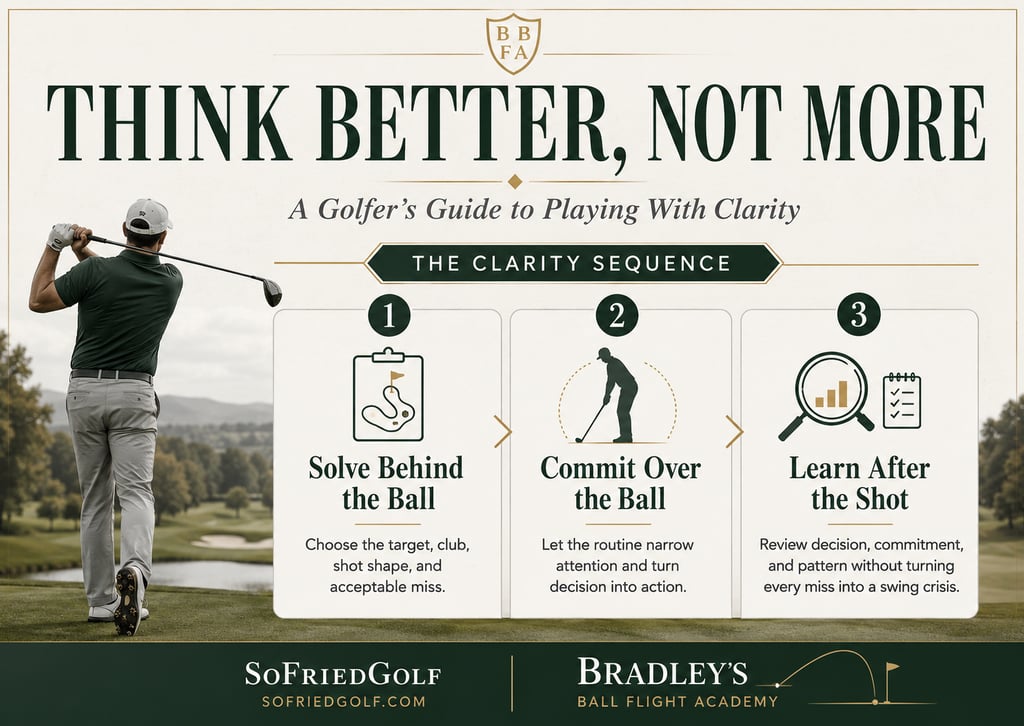
A golfer who wants to think better can begin with a simple three-part structure.
First, solve the shot behind the ball. Identify the target, start line, club, trajectory, and acceptable miss.
Second, reduce the swing cue to one task. Ideally, that cue should be external or intention-based: brush the grass, swing to the finish, start the ball over the window, roll it over the spot, clip the tee, send the ball to the tree. The cue should organize motion, not dissect it.
Third, review after the shot without emotional drama. Was the decision good? Was the commitment clear? Was the execution close to the intention? What pattern is emerging? The review should produce information, not identity judgment.
This final step matters because golfers often review the wrong thing. They judge shots only by outcome. But a good decision can produce a poor result. A poor decision can get lucky. A well-struck shot can be punished. A mishit can finish close. Golfers who evaluate only by result become emotionally unstable because the game contains too much randomness.
Better players evaluate decision quality, commitment, and pattern.
That is where the game becomes more playable. The golfer stops chasing perfect outcomes and starts building reliable processes. The mind becomes less interested in controlling every shot and more interested in selecting clear tasks.
The best coaching does the same thing. It does not fill the golfer’s head. It simplifies the player’s attention. It does not turn every miss into a flaw. It identifies whether the problem was decision, commitment, execution, or randomness. It gives the golfer language that can survive pressure.
Golf is already difficult. The player does not need to bring ten swing thoughts, three fears, two memories, and one vague target to the ball.
Think before the shot. Commit during the shot. Learn after the shot.
That is the rhythm.
The goal is not empty-minded golf. The goal is ordered-minded golf. A clear player is not one who never thinks. A clear player is one who knows when thinking should end.
Selected References
Broadie, M. (2014). Every shot counts: Using the revolutionary strokes gained approach to improve your golf performance and strategy. Gotham Books.
Gallwey, W. T. (1981). The inner game of golf. Random House.
Jensen, R. (2008). Easier said than done: A life in sport. Human Kinetics.
Masters, R. S. W., & Maxwell, J. P. (2008). The theory of reinvestment. International Review of Sport and Exercise Psychology, 1(2), 160–183.
Nilsson, P., & Marriott, L. (2011). Play your best golf now. Avery.
Rotella, B., & Cullen, B. (1995). Golf is not a game of perfect. Simon & Schuster.
Tomasi, T. J. (2000). The 30-second golf swing. Simon & Schuster.