
Tournament-Ready or Development-Ready? Rethinking How Young Golfers Grow
A golf-specific essay on how young players develop through curiosity, movement, skill-building, scaled play, guided practice, appropriate competition, and eventual ownership. This piece argues that junior golf should not be measured only by tournament entry or early results, but by whether the child is building the physical, technical, emotional, and motivational foundations needed for long-term growth in the game.
TEACHING THE YOUNG GOLFERFEATUREDCOLLEGE OF GOLFTHE SCIENCE OF LEARNING
Steven Bradley
7/5/202615 min read
Introduction: The Misleading Clarity of Junior Golf
Junior golf can make development look deceptively simple.
A child shows interest—a parent notices. A coach offers instruction. The player enters a clinic, joins a junior program, receives properly sized clubs, plays short holes, and eventually signs up for tournaments. If the child shows promise, the schedule can expand quickly: lessons, practice plans, local events, regional events, rankings, equipment decisions, camps, travel, and conversations about college golf long before the player has learned how to evaluate a round with emotional steadiness.
The pathway appears logical because golf is measurable. Scores provide numbers. Tournaments provide standings. Yardages provide benchmarks. Skills can be tested. Progress can be tracked. Compared with many team sports, golf seems unusually transparent.
But that transparency can mislead.
A young golfer can be tournament-exposed without being developmentally prepared. A child can play competitive rounds without understanding how to practice. A player can collect trophies without developing broad physical literacy. A junior can receive technical instruction without developing ownership of the material. A family can travel to events before anyone has asked whether the event matches the child’s stage, motivation, skill level, and emotional readiness.
This is the central distinction in junior golf: tournament-ready and development-ready are not the same thing.
Tournament readiness usually means the child can enter, complete, and perhaps compete in formal events. Developmental readiness is broader. It includes physical, technical, cognitive, emotional, and motivational foundations that can support long-term growth. Tournament play may be part of development, but it should not be confused with the whole.
If junior golf is understood through the philosophy of “Golf learning, not lessons,” then development cannot be reduced to swing correction or tournament entry. It has to be treated as a long-term process involving curiosity, play, movement, skill, feedback, appropriate challenge, parental support, competition, reflection, and eventually ownership.
The better junior golf pathway is not necessarily the one that rushes a child into seriousness. It is the one that helps the child become serious in the right way, at the right time, for reasons that can last.
I. Penick’s Starting Point: Interest Before Ambition
Harvey Penick gave one of the simplest answers to the question of when a child should begin golf. In Harvey Penick’s Little Red Book, he wrote that “the best age to start a child in golf is the time he or she becomes interested in the game.”
The wisdom of that sentence is its order. It begins with the child’s interest, not the adult’s ambition.
Many junior-development mistakes begin by reversing that order. The parent becomes interested first. A coach sees potential. A program identifies talent. A family recognizes a possible pathway. The child may enjoy the game, but that enjoyment is quickly surrounded by expectation. Golf becomes scheduled, measured, corrected, compared, and narrated before it has fully become the child’s own.
Penick’s view does not require adults to avoid structure. It does not suggest that children should learn entirely by accident. Rather, it points toward a developmental priority: curiosity is the first fuel. A child who wants to explore the game has something no coach can manufacture. The adult task is to protect and guide that energy, not immediately convert it into pressure.
That is especially important in golf because the game can become adult very quickly. It has rules, etiquette, equipment, technique, scoring, handicaps, rankings, and silence. A child can be made to feel inadequate before the game has become enjoyable. Early junior golf should therefore be concerned not only with whether the child learns the game, but with whether the child wants to return to it.
Programs such as Little Linksters reflect this principle by presenting golf through age-appropriate stages of readiness. The movement from range readiness to course readiness to tournament readiness is useful because it treats development as a progression rather than as an immediate performance demand. The program’s statement that “every child has a place in golf” is more than welcoming language. It is a reminder that junior golf should have room for different bodies, interests, personalities, timelines, and goals.
Golf can be a serious game without making childhood prematurely serious.
II. Tiger Woods, Jordan Spieth, and the Danger of a Single Developmental Myth
Junior golf has one unavoidable developmental ghost: Tiger Woods.
Woods is the most famous early-specialization story in golf history. His childhood has become part of the mythology of modern sport: a toddler with a club, a prodigious talent, a father who believed in his destiny, junior success at extraordinary ages, and a professional career that changed the sport. For parents and coaches, the Tiger story is both inspiring and dangerous. Inspiring because it shows what extraordinary early immersion can produce. Dangerous because it tempts adults to mistake an exceptional biography for a universal development plan.
Tiger Woods is evidence that early specialization can work for an exceptional child under exceptional circumstances. There is no evidence that every child should be pushed down the same path.
Jordan Spieth’s developmental story offers a useful contrast within golf itself. Before becoming a major champion and one of the few players to win the U.S. Junior Amateur more than once, Spieth was also a multi-sport athlete. Profiles of his youth describe football, baseball, basketball, and golf as parts of his athletic background. That does not mean Spieth became great because he delayed golf seriousness, any more than Woods became great only because he specialized early. The point is subtler: elite golf has room for more than one childhood pathway.
That matters because junior golf families often feel pressure to identify the “correct” route. The sport’s visibility structure — rankings, tours, national championships, recruiting attention, social media, and academy culture — can make the earliest and most intense pathway appear safest. But the developmental literature does not support such a simple conclusion.
David Epstein’s contrast between Tiger Woods and Roger Federer in Range is useful here because it shows that the broader sports world contains both kinds of stories. Some athletes specialize early. Others sample widely, build broad movement skills, and specialize later. Jean Côté’s developmental model of sport participation offers the research frame: sampling can contribute to motivation, movement variety, and long-term engagement before later specialization becomes appropriate.
The lesson is not that every junior golfer should copy Spieth, Federer, or Tiger. The lesson is that no single champion’s biography should become a child’s development policy.
III. Physical Literacy Before Golf Identity
Long-term athlete development models begin with a premise that golf families sometimes overlook: before a child becomes a golfer, the child is a mover.
Canada’s Long-Term Player Development model and the American Development Model both emphasize physical literacy, play, age-appropriate challenge, broad movement experience, and flexible progression. Their early stages are not organized around rankings or specialization. They are organized around the development of general movement competence and enjoyment.
This is not a rejection of skill. It is the foundation of skill.
Golf parents may be tempted to view non-golf play as time away from golf. Developmental research suggests a more complicated interpretation. Broad movement experiences can support long-term athletic development. Running, throwing, jumping, kicking, climbing, catching, balancing, striking, and rotating all contribute to a child’s athletic vocabulary. A young golfer who also plays soccer, basketball, baseball, tennis, gymnastics, martial arts, or informal outdoor games may be building a body that later learns golf more creatively and robustly.
The American Development Model’s support for multi-sport participation is especially relevant in a culture where early specialization is often sold as commitment. The sports-medicine literature has repeatedly warned that early specialization can increase the risk of overuse injuries and burnout, particularly when children train year-round in one sport without sufficient rest or variety. Golf may appear less physically violent than collision or field sports, but repetitive, one-dimensional development is still not ideal.
A junior golfer needs more than a golf swing. The developing player needs coordination, balance, rhythm, speed, mobility, strength, perception, patience, and confidence. Some of those qualities are trained through golf. Other forms of play enrich many.
This is not an argument against serious junior golf. It is an argument for carefully sequencing seriousness.
A child should not be asked to carry a golf identity before developing the physical, emotional, and motivational base that can support it.
IV. Parents as Support, Not Ownership
Parents shape junior golf more than almost anyone.
They provide transportation, pay fees, buy equipment, schedule lessons, encourage practice, interpret failure, celebrate progress, and decide which opportunities the child can access. A supportive parent can make golf possible. An over-involved parent can make golf feel burdensome. The difference is often not the amount of care, but the way that care is expressed.
Research on parental involvement in youth sports consistently points toward balance. Children benefit when parents provide emotional support, resources, and encouragement. They are more vulnerable when adult involvement becomes pressure, criticism, comparison, or control. Under-involvement can also be harmful because children often need adult support to access coaching, facilities, and competitive opportunities. The healthiest role is neither absence nor control. It is steady support with perspective.
Penick’s observation that “the best teacher of golf is a parent who loves the game” is best understood as a statement about atmosphere rather than technical authority. A parent who loves golf can invite a child into its rhythms: the walk, the quiet, the etiquette, the humor, the frustration, the beauty of a well-struck shot, the patience required after a poor one, and the small satisfaction of holing a putt. That influence is different from turning the car ride home into a technical review.
The car ride after a round is one of the most important classrooms in junior sports. It can teach perspective or pressure. It can help the child process the round or make the child dread adult evaluation. A parent does not have to ignore poor choices, lack of effort, or recurring habits. But timing and tone matter. Young golfers should not feel that every score produces a courtroom cross-examination.
A more useful parental posture is reflective rather than possessive. The parent can help the child notice what was learned, what was difficult, what improved, what remains unclear, and what the child wants to work on next. This helps the young golfer build ownership without being left alone.
Junior golf works best when adults provide support and children retain a growing sense that the game belongs to them.
V. What the Major Junior Golf Programs Reveal
Modern junior golf offers a range of development programs, each built around a different emphasis. None is complete by itself, but each reveals something important about what young golfers may need.
The First Tee is grounded in character development. Its mission is to help young people build strength of character through golf, and its curriculum emphasizes values such as honesty, integrity, respect, and perseverance. For beginners, recreational players, and families seeking a values-rich introduction, this matters. Golf is not merely a technique sport. It is a conduct sport. Children learn how to wait, count, lose, mark, repair, concede, encourage, and tell the truth.
Operation 36 offers a different developmental strength. Its model begins close to the hole and asks players to shoot 36 from progressively longer distances. This is pedagogically significant because it scales the challenge. Rather than asking a child to play adult golf from adult distances too early, it allows scoring competence to develop from shorter yardages. The child experiences success and progression while the task gradually becomes more complex.
PGA Jr. League provides golf with a social structure similar to that of other youth sports. Team formats, jerseys, coaches, and scramble competition can reduce pressure and increase belonging. This is important because golf can otherwise feel isolating to children who are accustomed to soccer, basketball, baseball, or softball environments. PGA Jr. League helps make golf communal.
U.S. Kids Golf contributes through competitive structure, age-based pathways, and properly fitted junior equipment. Its emphasis on equipment is especially important because children should not learn with clubs that are too long, too heavy, or mismatched to their strength and tempo. Competitive opportunities can also be valuable for children who are ready for them, provided competition is treated as part of development rather than the sole measure of it.
Taken together, these programs suggest a broader conclusion: junior golf development is not one thing. It includes character formation, scaled challenge, social belonging, proper equipment, technical learning, and appropriate competition. The mistake is treating any single component as the whole pathway.
VI. Tournament-Ready Is Not the Same as Development-Ready
Golf tournaments can be valuable learning environments. They teach rules, pressure, scoring, patience, preparation, emotional control, decision-making, and accountability. A young golfer cannot fully learn the game by remaining only on the range. At some point, the player has to put a score on a card and learn what golf asks when every shot counts.
The concern is not tournament golf itself. The concern is that tournament golf is introduced too early, too often, or for the wrong reasons.
A child may be able to complete a tournament round even if they are not developmentally prepared to interpret it. If the event becomes only a judgment of score, the player may learn fear rather than skill. If every tournament is treated as evidence of potential, the child may become outcome-obsessed. If competition replaces practice, the player may accumulate experience without turning it into improvement.
A tournament should reveal, challenge, and motivate development. It should not replace development.
A developmentally prepared junior golfer is gradually learning how to practice, understand ball flight, manage basic course strategy, recover emotionally after mistakes, keep score honestly, prepare before a round, and review afterward without turning every result into an identity judgment.
A tournament-ready child can enter an event. A development-ready child can learn from it.
That difference is easy to overlook because golf provides numbers. Scores make development look clean. But a score is only useful when it is interpreted. A 48 for nine holes may represent progress for one child, stagnation for another, and emotional overload for a third. The number itself does not explain the developmental meaning.
Coaches and parents should therefore treat tournaments as part of a feedback loop: preparation, competition, reflection, practice, adjustment, and future competition. Without that loop, tournaments become score collection.
VII. Junior Golf and the Travel Problem
Junior golf has its own version of the travel-sports economy.
Families drive to events, pay entry fees, book hotels, buy equipment, schedule lessons, and often evaluate progress through tournament results. For serious junior players, some travel may be necessary. Stronger fields, course variety, regional events, and ranking opportunities can all serve a developmental purpose at the appropriate stage.
But the same developmental-yield question applies: what is the child receiving in exchange for the cost?
Golf differs from team sports because the issue of playing time is less obvious. A junior golfer who enters an individual event usually plays the entire round. Unlike a substitute in soccer or basketball, the player is not necessarily sitting while others participate. But full participation does not automatically mean high developmental value. A child may hit every shot and still learn very little if no one helps translate the round into practice priorities.
The developmental value of tournament golf exists in the loop around the round. The player prepares, competes, reflects, practices, adjusts, and competes again. If that loop is missing, the family may be traveling primarily to collect scores and emotional reactions.
This is where junior golf can drift. The schedule expands, but the learning process remains vague. The player competes often but practices without purpose. The parent sees numbers but not patterns. The coach receives fragments instead of a full developmental picture. The child learns that golf is important, but not necessarily how to improve at it.
More tournaments may be useful for some players. For others, the better developmental choice may be fewer tournaments, clearer practice, more scaled play, more short-game competition, better course-management instruction, or more time in other sports.
Tournament volume should serve development, not define it.
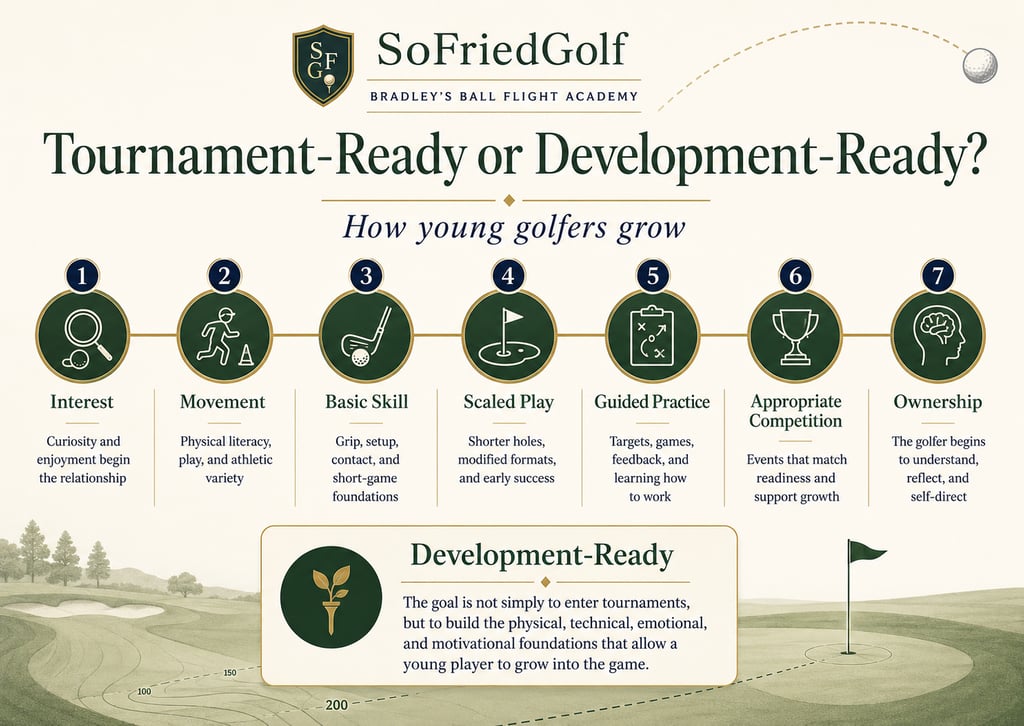
VIII. A More Developmentally Sound Junior Golf Pathway
A healthier junior golf pathway would not treat early competition as the primary marker of progress. It would ask whether the child’s technical skills, physical literacy, emotional readiness, parental environment, and intrinsic interest are growing in ways that can support a long-term relationship with the game.
The earliest stage should protect curiosity. Putting games, short shots, playful targets, family putting contests, and simple success can help the child associate golf with exploration rather than correction. From there, broad movement experiences and multi-sport participation can support coordination, balance, rhythm, and athletic confidence.
Basic golf skills should then be introduced in age-appropriate ways. Grip, aim, setup, safety, contact, putting, chipping, pitching, and full swing all matter, but they do not have to be delivered as adult technical lectures. The task is to build functional competence while preserving interest.
Scaled play should come before adult-course expectations. Shorter holes, modified tees, team formats, scrambles, and progression-based models such as Operation 36 can help children experience scoring and strategy without being overwhelmed by distance. This stage is crucial because it allows golf to become a game rather than a range exercise.
As the player matures, guided practice becomes more important. The young golfer begins learning how to work: choosing targets, playing games, using feedback, identifying patterns, managing repetition, and connecting practice to the course. At this stage, instruction should begin helping the player think, not merely comply.
Competition can then be introduced as readiness permits. The appropriate event is not necessarily the most prestigious event available. It is the event that provides useful challenge, emotional safety, and meaningful feedback. For some players, that may be a local nine-hole event. For others, it may eventually be a regional or national competition.
Over time, the goal is ownership. The junior golfer should gradually become capable of setting goals, reviewing rounds, recognizing ball-flight patterns, managing frustration, and taking responsibility for improvement. The coach and parent remain important, but the player becomes increasingly active in the process.
This sequence will not be identical for every child. Some move quickly. Some pause. Some return to earlier stages. Some remain recreational players. Some pursue high-level competition. A robust developmental model can accommodate diverse outcomes.
IX. What Coaches Should Teach Parents
Junior golf coaches do not only coach children. They also shape the adult environment around the child.
Parents often need help interpreting the pathway. Some do not know golf well enough to evaluate development. Others know enough golf to over-teach. Some are anxious about cost, rankings, college recruiting, or falling behind. Many are trying sincerely to make good decisions in a confusing marketplace.
A junior coach can provide an important perspective. Parents may need to understand that fun is not the opposite of seriousness, that properly fitted equipment matters, that multi-sport participation can support golf development, that tournaments should match readiness, and that scores should be reviewed carefully rather than emotionally.
They may also need help understanding that development is not always visible week to week. A child may be making meaningful progress in contact quality, emotional control, decision-making, or practice habits before those gains show up clearly in tournament scores. Conversely, a child may post a good score without practicing well or making sound decisions. Score matters in golf, but score is not the only evidence.
This kind of parent education may be one of the most valuable services a junior coach provides. A technically sound lesson can be weakened by an anxious car ride home. A healthy practice plan can be distorted by adult comparison. A child’s motivation can be strengthened or weakened by how parents interpret the process.
The coach’s responsibility is not only to improve the swing. It is to protect the learning environment.
Sometimes that means protecting it from well-intentioned adults.
X. Becoming a Golfer, Not Merely a Junior Competitor
The junior-golf literature and major developmental models point toward a broader definition of opportunity than tournament access alone. For young players, meaningful opportunities include entry into the game, appropriately sized equipment, safe and enjoyable early experiences, short-game competence, physical literacy, supportive coaching, and a family environment that encourages progress without taking ownership away from the child.
This broader view matters because a young golfer is not only learning a swing. They are learning to practice, interpret feedback, manage frustration, compete honestly, make decisions, and remain connected to the game long enough for their skills to mature.
In that sense, the aim of junior golf instruction is not merely to produce early tournament participation. The deeper aim is to cultivate the conditions under which a child can gradually become a golfer.
A junior competitor may know where the next event is. A golfer begins to understand what the game is asking. A junior competitor may collect scores. A golfer learns how to interpret them. A junior competitor may wait for instruction. A golfer slowly learns how to practice, adjust, and take responsibility.
This distinction matters because many children leave sports not because they lack talent, but because the environment failed to support long-term engagement. The game became too pressured, too expensive, too adult, too outcome-driven, or too disconnected from the child’s own reasons for playing.
A successful junior golf pathway should therefore be judged not only by early tournament results, but by whether the player’s relationship with the game is becoming stronger, more informed, and more self-directed over time.
Conclusion: Let the Game Grow With the Child
Junior golf development should not be rushed simply because the adult world has built pathways that can be entered early.
The existence of tournaments does not mean every child needs them immediately. The availability of instruction does not mean every session should be technical. The presence of rankings does not mean every score should carry adult weight. The possibility of college golf does not mean childhood should become a résumé.
A more developmentally sound pathway begins with the child: interest, movement, play, skill, challenge, support, competition, reflection, and ownership. It uses programs wisely. It treats parents as partners. It treats tournaments as tools. It treats ball flight as evidence. It treats enjoyment as a developmental resource rather than a lack of seriousness.
Tournament-ready is useful.
Development-ready is deeper.
The best junior golf pathway does not ask how quickly a child can be pushed into competition. It asks how steadily the child can grow into the game.
That is how golf becomes more than an activity.
That is how it becomes a lifelong relationship.
Selected References
American Academy of Pediatrics. (2024). Overuse injuries, overtraining, and burnout in young athletes. Pediatrics.
Balyi, I., Way, R., & Higgs, C. (2013). Long-Term Athlete Development. Human Kinetics.
Côté, J., Lidor, R., & Hackfort, D. (2009). ISSP position stand: To sample or to specialize? Seven postulates about youth sport activities that lead to continued participation and elite performance. International Journal of Sport and Exercise Psychology.
Deci, E. L., & Ryan, R. M. (2000). The “what” and “why” of goal pursuits: Human needs and the self-determination of behavior. Psychological Inquiry.
Epstein, D. (2019). Range: Why generalists triumph in a specialized world. Riverhead Books.
First Tee. (2023). Our mission and impact.
Fraser-Thomas, J., Côté, J., & Deakin, J. (2008). Understanding dropout and prolonged engagement in adolescent competitive sport. Psychology of Sport and Exercise, 9(5), 645–662.
Golf Canada. (2014). Long-Term Player Development Guide for Golf in Canada.
Jayanthi, N. A., Pinkham, C., Dugas, L., Patrick, B., & LaBella, C. (2013). Sports specialization in young athletes: Evidence-based recommendations. Sports Health.
Little Linksters. (n.d.). Little Linksters Roadmap.
Malina, R. M. (2010). Early sport specialization: Roots, effectiveness, and risks. Journal of Sports Sciences.
Nicklaus, J. (1974). Golf my way. Simon & Schuster.
Operation 36. (2025). How the program works.
Penick, H., & Shrake, B. (1992). Harvey Penick’s Little Red Book: Lessons and teachings from a lifetime in golf. Simon & Schuster.
PGA of America. (2020). American Development Model for Golf.
PGA Jr. League. (n.d.). Program overview.
Positive Coaching Alliance. (2025). Jordan Spieth on multi-sport play and youth development.
U.S. Kids Golf. (n.d.). Player pathway.
U.S. Olympic & Paralympic Committee. (2019). American Development Model.
Weinberg, R. S., & Gould, D. (2015). Foundations of sport and exercise psychology. Human Kinetics.
Weiss, M. R. (2000). Motivating kids in physical activity. President’s Council on Physical Fitness and Sports Research Digest.
Weiss, M. R., Bolter, N. D., & Kipp, L. E. (2013). Assessing impact of The First Tee’s life skills programs on positive youth development. University of Minnesota School of Kinesiology.
Wiersma, L. D. (2000). Risks and benefits of youth sport specialization: Perspectives and recommendations. Pediatric Exercise Science.