
Training Is Not the Goal
What Golfers Should Actually Be Building
FEATUREDCOLLEGE OF GOLF
Steven Bradley
7/9/20268 min read
Golfers love to ask what they should do.
What workout should I do?
How many balls should I hit?
Should I start speed training?
Should I lift heavier?
Should I stretch more?
Should I walk more?
Should I practice longer?
Should I hit another bucket?
Those are not bad questions. They are simply incomplete.
The better question is this:
What adaptation am I trying to create?
That question changes everything.
Golf improvement is often discussed as if more activity automatically produces better play. More range balls. More gym work. More swing speed. More rounds. More lessons. More drills. More effort. More grind.
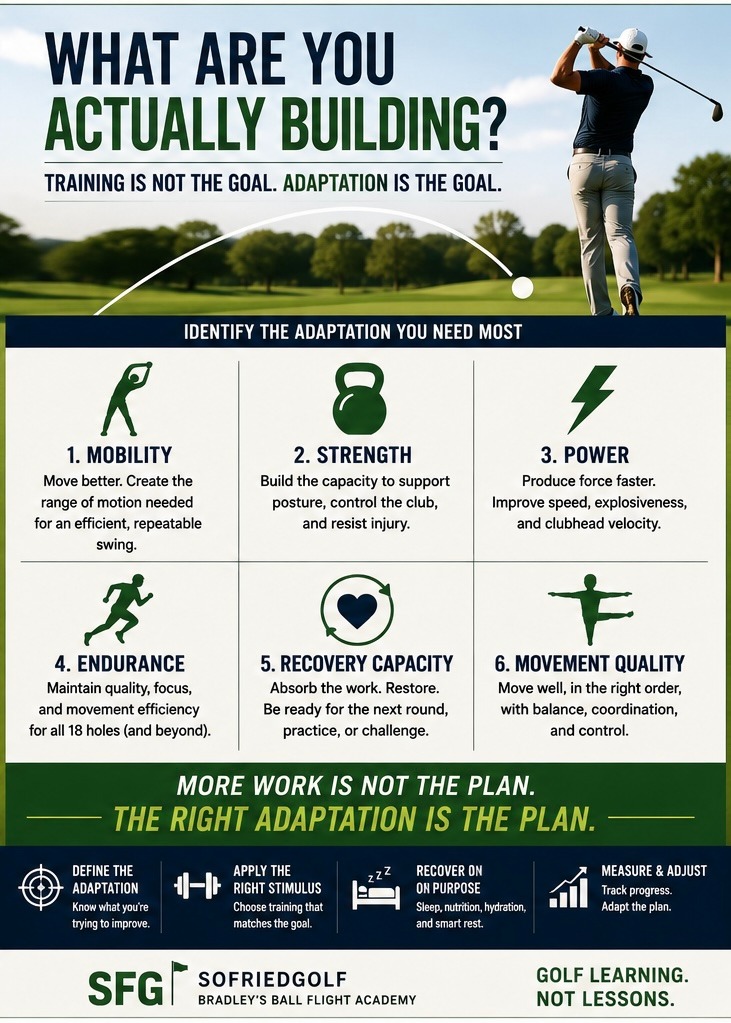
But golf does not reward effort by itself. Golf rewards usable improvement. The body must move better, produce force more efficiently, maintain attention longer, recover more completely, tolerate practice and play, and transfer training into ball flight and scoring. Training is not the goal. Training is the stimulus. Adaptation is the goal.
For golfers, that distinction matters because the game is technical, physical, mental, and nutritional at the same time. A swing is not produced by a club in isolation. It is produced by a person: a body with a certain amount of mobility, strength, balance, endurance, hydration, recovery, coordination, attention, and readiness.
If the player is not prepared, the swing is being asked to solve problems that are not purely swing problems.
The Workout Is Only the Stimulus
A workout does not automatically make a golfer better.
A mobility session does not automatically create a freer turn. A strength program does not automatically create more clubhead speed. A speed session does not automatically create playable distance. A long practice session does not automatically create better transfer to the course. A hard week of training does not automatically make the player more durable.
Each of those activities creates stress or practice exposure. The golfer still has to adapt.
That adaptation depends on the appropriateness of the stimulus and the quality of the recovery. If the work is too random, too intense, too frequent, too poorly matched to the player, or unsupported by sleep, hydration, nutrition, and recovery, the golfer may simply become tired. He may hit more balls without learning. She may train harder without moving better. He may chase speed before the body is ready to control it.
The question is not whether the golfer did the work.
The question is whether the work created a useful change.
Start With the Performance Problem
Golfers should begin by identifying the problem they are trying to solve.
Not every golfer needs the same adaptation. One player may need mobility. Another may need strength. Another may need endurance. Another may need recovery capacity. Another may need balance and movement quality. Another may need power. Another may simply need to stop arriving at the first tee underfed, dehydrated, stiff, and mentally scattered.
The same workout cannot be equally right for all of them.
A golfer who loses posture late in the round may not need a new swing thought first. He may need better walking capacity, trunk endurance, hydration, fueling, or pacing. A golfer who cannot make a full turn may not need speed training first. She may need mobility, stability, or a better warmup. A golfer who hits it shorter than his peers may need strength and power development, but he may also need to improve sequencing, contact, and movement quality. A golfer who plays well for 12 holes and fades late may not have a swing problem as much as a readiness problem.
This does not mean technique is unimportant. Technique matters enormously. Ball flight matters. Club delivery matters. Strike, face, path, low point, speed, and start direction matter.
But the body influences whether the golfer can produce those things repeatedly.
A better question than “What should I do?” is: “What is limiting my ability to produce the golf I want?”
Six Adaptations Golfers Commonly Need
1. Mobility
Mobility is the ability to move through useful ranges of motion with control. Golfers often think of flexibility as simply “being loose,” but golf requires more than passive range. The player must be able to turn, hinge, rotate, stabilize, and sequence movement while maintaining control of the club and body.
A golfer with limited mobility may compensate somewhere else. If the hips, thoracic spine, shoulders, or ankles do not contribute enough, the swing may borrow motion from the low back, change posture, shorten the turn, or alter the delivery pattern.
The goal is not to become flexible for its own sake. The goal is to create enough usable movement to support efficient golf motion.
2. Strength
Strength gives the golfer capacity.
It can support posture, control, tissue resilience, force production, and long-term durability. Golfers sometimes fear strength training because they imagine becoming tight, bulky, or less “feel-oriented.” That fear is usually misplaced when training is properly designed.
Strength does not need to make golf less athletic. It can make the golfer more capable.
The goal is not to lift like a powerlifter unless powerlifting is the sport. The goal is to build enough strength to support the demands of practice, play, speed, stability, and aging well.
3. Power
Power is the ability to produce force quickly.
In golf, power matters because clubhead speed matters. Distance is not everything, but it is an advantage when the player can control it. Modern golf has made speed training popular, and for good reason. Clubhead speed can be trained.
But speed work should be matched to readiness. A golfer with poor mobility, poor recovery, low strength, pain, or inconsistent movement quality may not be ready to add high-intensity speed sessions without first building a better base.
The goal is not merely to swing harder. The goal is to develop speed the body can produce, tolerate, and eventually transfer into playable shots.
4. Endurance
Golf is not a marathon, but golfers still need an engine.
A round can last four to five hours. Competitive golf may require walking, warmup, practice, decision-making, emotional regulation, and repeated precision under changing weather conditions. Tournament golf may require several rounds in a short period. Fatigue can affect concentration, patience, posture, tempo, decision-making, and fine motor execution.
Endurance for golfers does not need to look like endurance training for distance runners. But golfers benefit from enough cardiovascular and muscular endurance to maintain movement quality and attention across the full round.
The goal is not to become a marathoner. The goal is to still be a golfer on the 16th tee.
5. Recovery Capacity
Recovery capacity is the golfer’s ability to absorb work and be ready again.
This matters more than many amateurs realize. A player who practices hard, trains hard, works a full-time job, sleeps poorly, hydrates poorly, and plays in heat may not be undertrained. He may be under-recovered.
Recovery is influenced by sleep, nutrition, hydration, training load, stress, age, fitness level, and schedule. It is not a luxury. It is the process that allows training and practice to become improvement.
The goal is not to avoid hard work. The goal is to recover well enough for hard work to matter.
6. Movement Quality
Movement quality is the golfer’s ability to coordinate the body efficiently.
This includes balance, sequencing, posture, rhythm, control, and the ability to repeat movement under pressure. Some golfers chase strength or speed before they can control basic patterns. Others stretch constantly without improving how they move. Still others hit ball after ball while reinforcing compensations.
Movement quality connects the physical body to the golf swing.
The goal is not to look perfect in the gym. The goal is to move well enough that the swing has a better chance to organize around the task.
Why More Range Balls Are Not Always Better
Range balls are useful when they serve a purpose.
They can build skill, test ball flight, calibrate distance, develop contact, rehearse routines, explore patterns, and sharpen control. But more range balls are not automatically better. Practice is a stimulus too. If the golfer is tired, unfocused, under-recovered, or unclear about the task, additional reps may reinforce the wrong pattern.
A golfer should ask:
What am I training?
What ball flight am I trying to produce?
What feedback am I using?
Am I practicing a skill or simply repeating a habit?
Am I fresh enough for this work to be useful?
Will this transfer to the course?
A bucket without a task is not a development plan.
Why More Gym Work Is Not Always Better
Gym work should support the golfer, not compete with golf.
A good golf fitness plan does not need to be extreme. It should be specific enough to serve the player’s needs and general enough to build real athletic capacity. Mobility, strength, power, balance, endurance, and recovery can all matter. But the mix depends on the golfer.
A player who is already fatigued may need recovery before more intensity. A player with mobility restrictions may need movement work before heavy loading. A player chasing distance may need strength before speed. A player returning from pain should involve qualified medical or performance professionals rather than guessing through internet workouts.
The gym should help the golfer become more prepared to play.
It should not simply make the golfer feel like he trained.
Why More Speed Sessions Are Not Always Better
Speed training can be valuable.
It can help golfers increase clubhead speed, improve intent, and learn to move the club faster. But speed is a high-intensity adaptation. It places demands on the nervous system, tissues, coordination, and recovery. A golfer who adds speed work without considering readiness may increase fatigue, lose control, or irritate existing limitations.
Before chasing speed, golfers should ask:
Do I move well enough to swing faster?
Do I have enough strength to support more speed?
Am I recovering well?
Do I have pain?
Can I control strike and direction as speed increases?
Is my current practice organized enough to transfer speed into play?
Speed is not just a number. It is a capacity.
The goal is not to create a faster range swing. The goal is to create usable speed on the course.
The Adaptation Question
Before choosing a workout, practice plan, or speed program, golfers should identify the adaptation they need most.
A simple starting framework:
If you feel restricted, prioritize mobility and movement quality.
If you feel unstable, prioritize balance, trunk control, and strength.
If you feel weak or fragile, prioritize strength and recovery.
If you lose speed or posture late, prioritize endurance, hydration, fueling, and recovery capacity.
If you want more distance, build the foundation for power before chasing maximum speed.
If you practice often but do not improve, clarify the task and feedback.
This framework is not medical advice and does not replace individualized coaching or healthcare guidance. It is a better way to think.
Golfers do not need more random work.
They need the right work, recovered from well enough, repeated long enough, and connected clearly enough to the golf they are trying to play.
Conclusion: Build the Golfer, Not Just the Swing
Golfers are often tempted by the promise of the missing move.
One swing tip. One secret drill. One speed trick. One stretch. One workout. One answer.
But golf improvement rarely works that way. The swing matters, but the swing belongs to the player. The player brings a body, a brain, an energy level, a recovery state, a movement history, and a set of physical capacities to every shot.
Training is not the goal.
Adaptation is the goal.
The golfer should not ask only, “What should I do?” The golfer should ask, “What am I trying to build?”
More mobility.
More strength.
More power.
More endurance.
Better recovery.
Better movement.
Better transfer.
Better readiness.
That is golf learning.
Not lessons. Not magic tips. Not random effort.
A clearer system for becoming more capable.
Selected References
Bompa, T. O., & Buzzichelli, C. (2019). Periodization: Theory and methodology of training.
Dube, A., Moffatt, R., & Goodall, S. K. (2022). Effects of hypohydration and fluid balance in athletes’ cognitive performance.
Jäger, R., et al. (2017). International Society of Sports Nutrition position stand: Protein and exercise.
Kerksick, C. M., et al. (2018). ISSN exercise & sports nutrition review update: Research & recommendations.
Smith, M. F. (2010). The role of physiology in the development of golf performance.
Thomas, D. T., et al. (2016). Nutrition and athletic performance.
Wells, G. D., Elmi, M., & Thomas, S. (2009). Physiological correlates of golf performance.