
The Golfer Is the Program
What can a fictional collegiate player teach real golfers about training, nutrition and improvement?
FEATUREDCOLLEGE OF GOLF
Steven Bradley
7/14/202614 min read
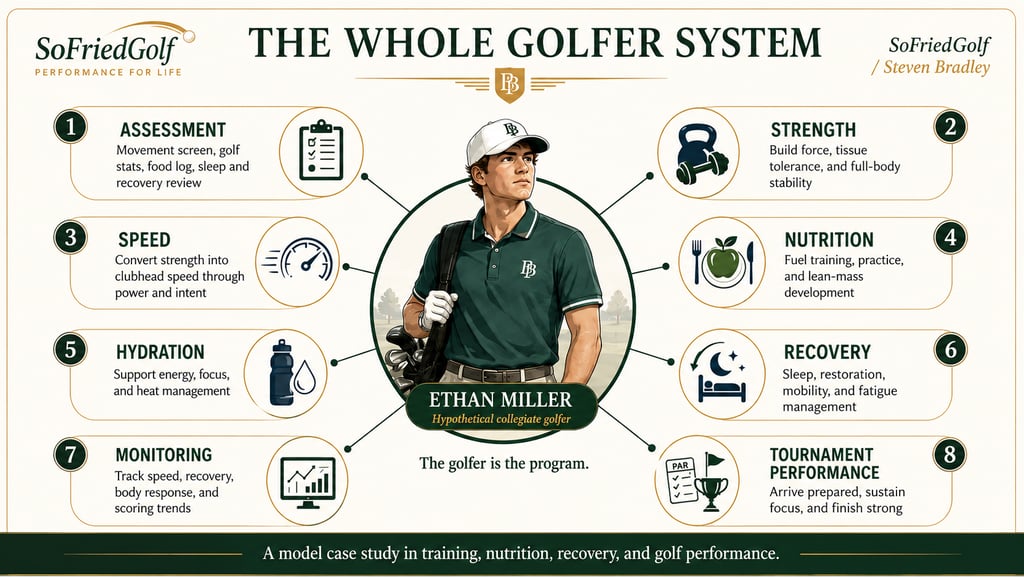
Ethan Miller is a 20-year-old NCAA Division II golfer entering his junior season.
He is 6 feet tall, weighs 178 pounds, and carries a scoring average of 73.8. His driver clubhead speed averages 109 mph. His coach reports that he tends to lose posture and decision quality late in 36-hole tournament days. His goals are specific: increase average clubhead speed to 114 mph, add about five pounds of lean mass without sacrificing mobility, improve walking and recovery capacity during multi-day events, and reduce recurring low-back tightness after long practice weeks.
His training background is not unusual for a serious young player. He has lifted recreationally, but he has not followed a structured annual plan. His nutritional habits also leave room for improvement: inconsistent breakfasts, low carbohydrate intake during rounds, high caffeine intake before competition, and inadequate fluid intake during travel days.
Ethan is not a real client. He is a hypothetical player developed as part of an academic project in golf fitness and nutrition. That distinction matters. This is not a case study of a private student, nor is it a testimonial.
But Ethan’s situation is useful because it represents a common problem in golf improvement: the player wants better performance, but the performance problem is not isolated to one swing flaw, one exercise, one meal, or one round of poor decision-making. His goals involve strength, speed, mobility, endurance, fueling, hydration, recovery, and tournament readiness.
That is the point of building a model around him.
A golfer’s improvement plan should begin with the golfer, not with a list of exercises or a favorite drill. Golf performance is technical, but the swing is produced by a body that has to generate force, regulate energy, recover from training, and repeat decisions under competitive stress. Ethan’s plan was built around that premise: training is the stimulus, but adaptation is the goal.
For real golfers, the value of Ethan’s plan is not that they should copy it exactly. Most golfers are not 20-year-old collegiate players trying to peak across fall and spring competition seasons. The value is in the process: assess the player, identify the demands, match training and nutrition to the goal, monitor the evidence, and adjust the plan when the evidence changes.
Begin with an assessment
The first step in Ethan’s program is not a workout. It is an assessment.
The proposed intake includes movement screening, hip and thoracic mobility testing, countermovement jump, medicine ball throw distance, grip strength, resting heart rate, body composition, golf performance statistics, a three-day food log, sweat-rate testing, and a sleep/recovery questionnaire.
That list is more extensive than most recreational golfers need. Still, it illustrates an important principle: an effective plan should be based on the player’s actual needs rather than a generic idea of what “golf fitness” looks like.
Ethan wants more clubhead speed, but the plan does not treat speed as a separate issue. His speed goal is connected to force production, strength development, power expression, tissue tolerance, warm-up quality, and recovery. He wants better late-round performance, but the plan does not assume that late-round decline is purely mental. It considers walking capacity, hydration, nutrition, fatigue, and tournament routine. He wants to reduce low-back tightness, but the plan does not prescribe a single corrective exercise without first considering mobility, load management, strength, and the accumulation of practice stress.
That is the practical difference between a program and a collection of tips.
The assessment gives the coach and player a starting point. It also helps determine which problem is most likely to matter. A player who loses shots primarily through three-putts does not need the same plan as a player who loses shots through penalty drives. A player who fades late in tournaments does not need the same plan as a player who lacks basic strength or mobility. A player who wants more speed may need a different sequence than a player who wants to play without pain.
Ethan’s plan begins by identifying the performance demand before prescribing the response.
Build the year around the player’s calendar
Ethan’s program is organized as a 12-month macrocycle with two competitive seasons. The year includes transition and testing, general preparation, strength development, power and speed conversion, fall in-season maintenance, winter regeneration, spring preparation, spring competition, and post-season evaluation.
That structure matters because a golfer cannot train every quality at full volume all year. The purpose of training changes depending on the season.
During transition and testing, the plan emphasizes active recovery, movement screening, baseline metrics, light aerobic work, mobility restoration, food logging, hydration assessment, and consistency with breakfast. During general preparation, the emphasis shifts toward three to four strength sessions per week, aerobic base development, mobility, trunk endurance, basic jumps and throws, a small energy surplus, adequate protein intake, and carbohydrate intake matched to training load. Later phases shift toward max strength, power, medicine ball throws, sprint primers, speed work, tournament fueling, in-season maintenance, recovery, and tapering.
For a collegiate golfer, this annual organization is essential because the competitive calendar creates different demands at different times. The summer can support more developmental training because weekly tournament fatigue is lower. Preseason can shift toward power and speed. In-season training should maintain key physical qualities without causing soreness or fatigue that interfere with competition. Championship periods require tapering and readiness.
Most amateur golfers do not need that level of formal periodization. But they can still use the same principle.
A golfer preparing for a club championship should not train the same way as a golfer rebuilding during the offseason. A junior in tournament season needs a different workload than a junior in winter preparation. A player returning from back pain should not immediately begin high-intensity speed work. A senior golfer trying to maintain mobility and balance needs a plan that reflects age, schedule, recovery, and goals.
The question is not only what to do. It is when to do it and why.
Strength before speed
Ethan wants to increase driver clubhead speed from 109 mph to 114 mph. The plan treats that as a reasonable goal, but it does not begin with unrestricted overspeed training or maximum-effort driver swings.
The early training phase emphasizes anatomical adaptation, tissue tolerance, and movement quality. Exercises include goblet squats, split squats, Romanian deadlifts, rows, push-ups, Pallof presses, carries, hip airplanes, thoracic mobility, and low-level jumps. Later, the program progresses toward full-body strength sessions built around trap-bar deadlifts, front squats, split squats, hip thrusts, chin-ups or pulldowns, landmine presses, and cable rows. Accessory work targets hip mobility, hamstring strength, trunk endurance, scapular control, and ankle stability.
That sequence reflects the goal's logic. Clubhead speed is influenced by force and power, but power training is more useful when the athlete has sufficient strength, mobility, coordination, and recovery capacity to benefit.
The research cited in Ethan’s plan supports strength and power training as part of golf performance development. Wells, Elmi, and Thomas found relationships between golf performance and physical qualities such as core strength and stability, flexibility, balance, and peripheral muscle strength. Ehlert’s systematic review reported that many strength and conditioning studies showed performance benefits, with significant findings averaging 4% to 6.4% improvements in clubhead speed, ball speed, or distance. Oranchuk and colleagues found that eight weeks of strength and power training improved average clubhead speed in NCAA Division II golfers.
That does not mean every golfer should train like a college athlete. It does mean that strength and power are legitimate parts of golf improvement when they are matched to the player’s needs and introduced with appropriate progression.
In Ethan’s case, the plan builds the strength platform first. Speed work appears later, after preparation. When overspeed training is introduced, it is conservative: 2 sessions per week, 15-25 total maximal swings, radar feedback, and at least 48 hours between sessions. The goal is not simply to swing harder. The goal is to access higher movement speeds while preserving mechanics and avoiding excessive soreness.
That distinction is useful for any golfer interested in speed. Speed training is not automatically wrong. It is also not automatically appropriate. It should be placed inside a broader plan that accounts for the player’s body, schedule, recovery, and golf goals.
Conditioning still matters
Golf is not an endurance sport like running or cycling. The swing itself is short and explosive. But competitive golf still places meaningful demands on the body over time.
Berlin, Cooke, and Belski noted that elite golf may involve four to eight hours on the course and walking distances up to 20 kilometers in a day. Ethan’s own performance issues include a late-round decline in posture and decision quality on 36-hole tournament days.
For that reason, his plan includes aerobic work: two weekly zone-two sessions of 30 to 45 minutes, performed briskly by walking, cycling, or incline treadmill work, plus one long walking round when possible.
This is not presented as a substitute for skill work or strength training. It is included because Ethan’s competitive problem involves sustaining performance over long days. Aerobic conditioning can support recovery capacity, general work capacity, and tolerance for the physical demands of tournament golf.
For recreational players, the application is simple. A golfer who rides in a cart on weekends may not need formal aerobic programming. A player who walks, competes in heat, plays multi-day events, or notices late-round fatigue may benefit from improving general conditioning. The purpose is not to become a distance runner. The purpose is to remain physically and mentally prepared through the final holes.
Conditioning should be tied to the player’s actual golf environment. A high school player walking 18 holes in summer heat, a college player facing 36-hole days, a senior golfer trying to maintain stamina, and a recreational player who plays only 9 holes after work do not have identical needs. The useful lesson is to match the conditioning plan to the demand.
Nutrition has to support the goal
Ethan’s nutrition program is built to support lean mass gain, training adaptation, cognitive performance, hydration, and tournament endurance. The foundation is a food-first approach: lean proteins, fruits, vegetables, whole grains, potatoes, rice, oats, dairy or fortified alternatives, nuts, seeds, olive oil, and adequate fluids.
The plan sets protein at 1.6 to 2.0 grams per kilogram per day, or roughly 130 to 160 grams per day for Ethan, distributed across meals and snacks. That recommendation is grounded in the International Society of Sports Nutrition position stand cited in the original project, which reported that 1.4 to 2.0 grams per kilogram per day is sufficient for most exercising individuals seeking to build or maintain muscle mass. Ethan’s carbohydrate intake is periodized: lower on lighter days, higher on heavy lifting and long practice days, and higher still before 36-hole or high-heat tournament days.
The important point for most golfers is not the exact number. It is important that nutrition matches the work.
A golfer trying to add strength or speed while chronically under-fueling is working against the adaptation he wants. A player who eats inconsistently before competition should not be surprised if energy, attention, or mood fluctuates during the round. A golfer who relies heavily on caffeine without adequate food, sleep, or hydration may be using caffeine to cover a lack of preparation.
Ethan’s tournament nutrition plan is specific. Breakfast includes oats or toast, eggs or Greek yogurt, fruit, and fluids. During the round, the goal is steady intake: water every hole, electrolytes in heat, and 30 to 45 grams of carbohydrate per hour from options such as bananas, trail mix, pretzels, energy chews, peanut butter sandwiches, or sports drinks. After the round, the plan calls for 25 to 40 grams of protein plus carbohydrates within two hours, followed by a full meal when possible.
That is not complicated. It is preparation.
Many golfers devote significant attention to equipment and swing mechanics while treating fueling as an afterthought. Ethan’s model shows that nutrition is not separate from performance. It supports the training process and the competitive round.
Hydration should be planned, not guessed
Hydration is individualized in Ethan’s program through sweat-rate testing. The plan recommends beginning practice and competition already hydrated, using urine color and body-mass changes as field checks, and avoiding losses greater than approximately 2% of body mass when feasible. For hot-weather tournaments, Ethan travels with two bottles: one of water and one of an electrolyte/carbohydrate solution.
Most golfers do not need to weigh themselves before and after every round. But serious players, especially those competing in heat, can benefit from knowing how much fluid they tend to lose and how their performance changes when hydration is neglected.
The plan also addresses caffeine. Because Ethan currently uses high caffeine before competition, caffeine should be limited to a planned dose rather than used as a stress habit. It should be tested in practice and should not replace food, sleep, or hydration.
That is a practical point for golfers at many levels. Caffeine can be useful for some athletes, but it is not a complete preparation strategy. Used poorly, it may hide fatigue without addressing the reasons the player feels unprepared.
Hydration and fueling are not glamorous parts of golf improvement. They also do not require a swing rebuild. That is part of their value. For many players, better round preparation is one of the simplest ways to support more consistent performance.
In-season training should protect performance
One of the more useful parts of Ethan’s plan is the shift from developmental training to in-season maintenance.
During fall and spring competition, the purpose of training changes. Ethan is no longer trying to aggressively build every quality. He is trying to preserve strength, speed, mobility, and readiness while limiting fatigue. The plan includes two brief strength sessions when tournament timing allows. One emphasizes lower-body strength and pulling; the other emphasizes power and mobility. Loads remain heavy or moderate enough to preserve strength, but total volume is kept low. During tournament weeks, lifting should occur early in the week and should not cause soreness close to competition.
Tapering is also built into the plan leading up to championship events. The final week reduces lifting volume by approximately 40% to 60% while retaining short speed exposures, mobility, and technical practice. The goal is for the athlete to arrive fresh, not exhausted.
This is one of the clearest lessons for competitive golfers.
The best training plan is not the one that looks hardest on paper. It is the one that supports performance at the right time. A player who creates gym soreness before an important tournament has not proven commitment. He has mismanaged readiness. A player who adds last-minute technical volume before a championship may be responding to anxiety more than need.
Ethan’s plan emphasizes practice during championship week to build competitive readiness, wedge distance control, putting, course strategy, and confidence, rather than high-volume range work.
That is a useful model because it connects training decisions to tournament demands. The player is not training in isolation. He is preparing to perform.
Monitoring keeps the plan accountable
A serious plan has to be monitored. Ethan’s program includes both objective and subjective measures.
Weekly measures include body weight, resting heart rate, sleep duration, perceived recovery, soreness, practice quality, and rating of perceived exertion during training sessions. Monthly measures include clubhead speed, medicine ball throw, countermovement jump, mobility checkpoints, and key golf statistics. Ethan also tracks the final-six-hole scoring average because late-round performance is one of his stated concerns.
The last detail is important. Monitoring should reflect the goal.
If a player wants more speed, clubhead speed and relevant power markers matter. If a player wants better late-round performance, late-round scoring and fatigue indicators matter. If a player wants reduced pain, soreness, mobility, load, and recovery become important. If a player wants lower scores, the plan should track the places where strokes are actually lost.
Monitoring does not have to become complicated. For most golfers, a simple scorecard review may be enough to reveal obvious patterns: penalties, three-putts, failed up-and-downs, approach misses, short-sided recoveries, or poor wedge distance control. More competitive players may need deeper tracking.
The principle is the same. The plan should be adjusted based on evidence.
Ethan’s program explicitly allows for changes. If low-back tightness worsens, heavy spinal loading should be reduced and an athletic trainer or physical therapist should evaluate the player. If body mass increases too quickly, calorie intake should be adjusted. If speed declines late in the season, lifting volume should decrease and readiness should be prioritized.
That flexibility is a strength, not a weakness. A good plan is not a script to follow blindly. It is a framework for making better decisions as the player responds.
What Ethan teaches real golfers
Ethan is a college player model, but the lessons apply well beyond college golf.
The first lesson is to define the player before defining the program. Age, goals, training history, injury history, schedule, practice access, competitive level, and scoring pattern all matter. A plan for a college golfer should not look exactly like a plan for a junior beginner, a 15-handicap adult, or a senior player trying to maintain mobility and distance.
The second lesson is to define the adaptation being pursued. “Improve” is too broad. More clubhead speed, better short-game conversion, fewer three-putts, improved late-round endurance, lower injury risk, stronger tournament routines, and better wedge control are different goals. They require different emphasis.
The third lesson is to sequence the work. Ethan builds movement quality and strength before pushing speed. He practices tournament nutrition before relying on it in competition. He uses in-season training to maintain readiness rather than chase heavy development during tournament weeks.
The fourth lesson is to include nutrition and hydration in the performance plan. Food and fluids are not only general wellness concerns. They help determine whether the golfer can train, recover, and compete effectively.
The fifth lesson is to monitor what matters. Data are useful when they answer the right question. Ethan tracks final-six-hole scoring because that connects to his actual performance problem. Other players may need different measures.
The final lesson is that improvement is an integrated process. The swing matters, but it does not exist outside the golfer. Physical capacity, fatigue, practice design, nutrition, hydration, sleep, recovery, and competitive demands can all influence how consistently the golfer performs.
A model, not a template
Ethan Miller should not be copied. He should be studied.
His plan is built around a specific fictional player: a 20-year-old collegiate golfer with a 73.8 scoring average, 109 mph clubhead speed, late-round performance issues, low-back tightness, and defined goals for speed, lean mass, endurance, and recovery.
A different golfer would need a different plan.
But the process is transferable:
Start with the athlete.
Identify the demands.
Assess the limiting factors.
Build the training and nutrition plan around the goal.
Monitor the response.
Adjust when the evidence changes.
That is what makes Ethan a useful SFG case study. He shows that golf improvement can be treated as a serious performance project without becoming unnecessarily complicated. The plan is not a collection of unrelated fitness and nutrition ideas. It is an organized attempt to help a golfer become better prepared for the golf he is trying to play.
For recreational golfers, that may mean a simpler version: a better warm-up, two strength sessions per week, more walking, a basic hydration plan, fewer skipped breakfasts, short-game testing, and a clearer practice schedule.
For competitive golfers, it may mean a formal annual plan.
For coaches, it means resisting the temptation to prescribe before assessing.
The golfer is the program because the right plan depends on the person trying to improve.
Selected References
Berlin, N., Cooke, M. B., & Belski, R. (2023). Nutritional considerations for elite golf: A narrative review. Nutrients, 15(19), 4116. https://doi.org/10.3390/nu15194116
Bompa, T. O., & Buzzichelli, C. (2019). Periodization: Theory and methodology of training (6th ed.). Human Kinetics.
Dunford, M., & Doyle, J. A. (2022). Nutrition for sport and exercise (5th ed.). Cengage Learning.
Ehlert, A. (2020). The effects of strength and conditioning interventions on golf performance: A systematic review. Journal of Sports Sciences, 38(23), 2720–2731. https://doi.org/10.1080/02640414.2020.1796470
Fradkin, A. J., Sherman, C. A., & Finch, C. F. (2004). Improving golf performance with a warm-up conditioning programme. British Journal of Sports Medicine, 38(6), 762–765. https://doi.org/10.1136/bjsm.2003.009399
Jäger, R., Kerksick, C. M., Campbell, B. I., Cribb, P. J., Wells, S. D., Skwiat, T. M., Purpura, M., Ziegenfuss, T. N., Ferrando, A. A., Arent, S. M., Smith-Ryan, A. E., Stout, J. R., Arciero, P. J., Ormsbee, M. J., Taylor, L. W., Wilborn, C. D., Kalman, D. S., Kreider, R. B., Willoughby, D. S., ... Antonio, J. (2017). International Society of Sports Nutrition position stand: Protein and exercise. Journal of the International Society of Sports Nutrition, 14(1), Article 20. https://doi.org/10.1186/s12970-017-0177-8
Mah, C. D., Kezirian, E. J., Marcello, B. M., & Dement, W. C. (2018). Poor sleep quality and insufficient sleep of a collegiate student-athlete population. Sleep Health, 4(3), 251–257. https://doi.org/10.1016/j.sleh.2018.02.005
Oranchuk, D. J., Mannerberg, J. M., Robinson, T. L., & Nelson, M. C. (2020). Eight weeks of strength and power training improves club head speed in collegiate golfers. Journal of Strength and Conditioning Research, 34(8), 2205–2213. https://doi.org/10.1519/JSC.0000000000002505
Sawka, M. N., Burke, L. M., Eichner, E. R., Maughan, R. J., Montain, S. J., & Stachenfeld, N. S. (2007). American College of Sports Medicine position stand: Exercise and fluid replacement. Medicine & Science in Sports & Exercise, 39(2), 377–390. https://doi.org/10.1249/mss.0b013e31802ca597
Thomas, D. T., Erdman, K. A., & Burke, L. M. (2016). Position of the Academy of Nutrition and Dietetics, Dietitians of Canada, and the American College of Sports Medicine: Nutrition and athletic performance. Journal of the Academy of Nutrition and Dietetics, 116(3), 501–528. https://doi.org/10.1016/j.jand.2015.12.006
Wells, G. D., Elmi, M., & Thomas, S. (2009). Physiological correlates of golf performance. Journal of Strength and Conditioning Research, 23(3), 741–750. https://doi.org/10.1519/JSC.0b013e3181a07c6b