
The Only Secret Is That There Are No Secrets
What modern swing science actually teaches about sequence, ground force, and the myth of the perfect golf swing
COLLEGE OF GOLFFEATURED
Steven Bradley
7/15/202612 min read
Golfers have always searched for the secret.
The grip secret. The plane secret. The tempo secret. The wrist secret. The lower-body secret. The move that makes the game make sense. The feeling that keeps the ball in play. The model that makes the swing repeat. The one instruction that finally turns a complicated game into something dependable.
That search is understandable. Golf invites it.
The task sounds simple: strike a ball toward a target. The execution is not simple at all. A small difference in face angle, path, contact point, low point, rhythm, pressure shift, or timing can separate a playable shot from a lost ball. A golfer can make what feels like the same swing twice and watch the ball do two completely different things. Under those conditions, the idea of a hidden answer becomes attractive.
Golf instruction has often fed that appetite. Across generations, teachers, players, books, magazines, videos, training aids, and method systems have promised clearer models of the swing. Some of those models have been useful. Many were built from real observations of great players. Others were sincere attempts to reduce a difficult motion into a teachable structure.
But the longer golf science has studied the swing, the less convincing the idea of one perfect swing has become.
The modern lesson is not that swing mechanics do not matter. They matter enormously. The lesson is more precise: there is no universal swing model that belongs to every golfer. There are universal impact laws, but different bodies, different histories, different levels of mobility, different equipment, different practice habits, and different playing goals must apply them.
That may disappoint golfers who want a secret. It should encourage golfers who want a better way to learn.
The only secret is that there are no secrets.
There are, however, solutions.
From the perfect swing to useful impact
One of the enduring themes in golf instruction is the search for a repeatable model. Alec Cochran and John Stobbs’ Search for the Perfect Swing helped bring physics and scientific analysis into golf instruction, advancing the conversation around momentum transfer, leverage, and impact geometry. The limitation was not that the work did not take science seriously. The limitation was the implication many golfers and teachers later attached to the idea: that a scientifically informed swing might eventually become one idealized pattern for everyone.
That idea has always been difficult to defend in practice.
Great players do not all swing alike. Ben Hogan, Jack Nicklaus, Lee Trevino, Jim Furyk, Tiger Woods, Annika Sörenstam, Rory McIlroy, Jon Rahm, Nelly Korda, Scottie Scheffler, and countless others demonstrate that elite performance can emerge from different patterns. Some swings look classical. Some look idiosyncratic. Some rely on length and flow. Others rely on compactness and rotation. Some players use visible footwork. Others look quiet. Some match the textbook better than others. The ball does not care.
The ball responds to impact.
That shift—from how a swing looks to what the club and ball actually do—may be the most important development in modern instruction. Ball-flight laws reframed the swing as a cause-and-effect system. The face, path, angle of attack, centeredness of contact, and clubhead speed became the primary variables that explain what the ball does after impact. In the original academic project this piece is adapted from, that transition is described as moving from mythologizing the perfect swing to operationalizing effective, individualized swings.
That distinction matters for everyday golfers.
A golfer who slices the ball does not need to be told only that the swing is ugly, steep, over the top, or wrong. The more useful question is what happened at impact. Where did the face point? What was the path? Where did contact occur? Was the strike high, low, heel, or toe? Was the angle of attack helping or hurting? Was speed being produced efficiently?
Those questions do not eliminate the need for coaching judgment. They improve it.
They also help protect golfers from unnecessary reconstruction. A swing that looks unusual may produce functional impact. A swing that looks polished may produce poor impact. The goal is not to win a beauty contest on video. The goal is to send the ball where the golfer intends, often enough and well enough to play the game.
Why the myth survived
The myth of the perfect swing has not disappeared because it offers something golfers badly want: certainty.
A method can feel safe. A model can feel clean. A player who is struggling may prefer being told exactly where to put the club, the hands, the knees, the shoulders, the hips, and the head. The promise of a system can be comforting because it turns confusion into order.
That does not make all systems useless. Some methods help some golfers. A one-plane model, a rotational model, a stack-and-tilt pattern, a neutral-grip system, a strong-grip system, or a lead-side pattern may serve the right player at the right time. Good teachers have always used models as tools.
The problem begins when the model becomes the master.
If the player’s body, ball flight, mobility, intention, learning style, and playing goals must all be forced into a single pattern, instruction becomes less about solving the golfer’s problem and more about preserving the theory. That is where model-based coaching can create tension with evidence-based individualization.
The better view is less rigid: the swing has to obey physics, but it does not have to imitate one preferred style.
That is the useful inheritance of older swing models. Hogan’s precision, Nicklaus’ athleticism, persimmon-era tempo, modern rotational ideas, and contemporary speed systems all preserve pieces of the game’s learning history. They are not worthless. They are not universal. They are stepping stones toward a better understanding of the swing: measurable impact laws applied through individual movement solutions.
The swing is not a set of positions
Modern biomechanics has also changed how golfers think about motion.
For much of golf instruction's history, the swing was often taught through positions: takeaway, top, shaft plane, impact, release, and finish. Positions are not meaningless. Video can help a golfer see relationships that are otherwise hard to perceive. A coach may need to identify a clubface, shaft, posture, or pivot pattern that is clearly affecting impact.
But positions are snapshots. The swing is motion.
The transition from model-based instruction to evidence-based coaching accelerated when researchers began using high-speed video, force plates, and motion-capture systems to study what actually happens during skilled swings. Those tools showed the golf swing as a coordinated sequence rather than a collection of static shapes. Energy moves through the body, segments accelerate and decelerate, pressure shifts, and the club arrives at impact as the product of the entire motion.
That is why a still image can mislead.
A golfer can copy the look of a position without producing the forces or sequence that made the original position functional. A player can get the club “on plane” in a still frame and still have no useful rhythm, pressure shift, or face control. Another player may look unusual in the backswing, but organizes the club beautifully through impact.
The question is not only where the club is.
The question is how the golfer got there, what the body was doing to support it, and whether the pattern produces useful ball flight.
What sequencing actually means
One of the most important biomechanical concepts in the golf swing is kinematic sequencing.
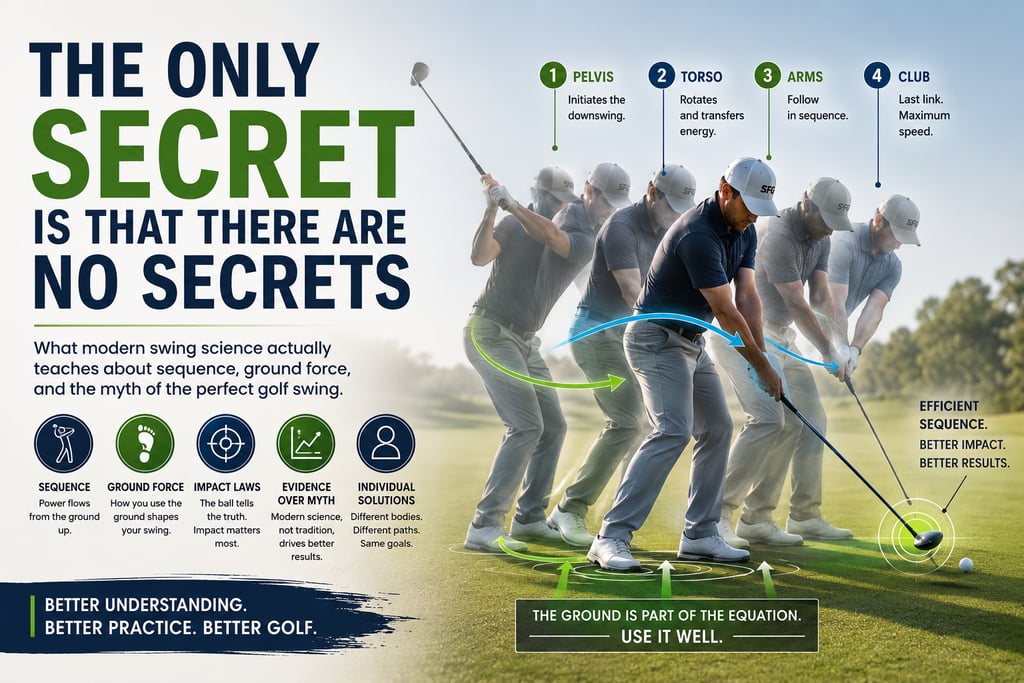
In simple terms, skilled golfers tend to generate speed through a coordinated transfer of force from larger to smaller body segments. Research discussed in the original project describes this as a proximal-to-distal sequence: the pelvis initiates the downswing, followed by the torso, then the arms, and finally the club. Each segment accelerates, decelerates, and transfers energy to the next.
That is not a decorative detail. It helps explain why some golfers generate speed that seems disproportionate to their size.
The clubhead is the final link in the chain. It is not supposed to be the engine at the start of the downswing. When the hands and arms rush from the top, the golfer may produce effort, but not necessarily efficient speed. The club can be thrown early, the sequence can collapse, the body can stall, and the player may have to rescue impact with timing.
A better sequence does not mean the golfer should consciously fire body parts in a rehearsed order. That approach can become mechanical very quickly. Sequencing is more useful as a training concept than an over-the-ball thought. The player learns to feel how pressure, rotation, and momentum organize the motion so that the club can be delivered with less manipulation.
This is where many golfers misunderstand power.
They try to add speed by adding arm effort. Sometimes that produces more speed, but often at the cost of contact, face control, low point, balance, or start line. Modern swing science suggests that many golfers would be better served by improving the order and efficiency of the motion rather than simply trying harder from the top.
The goal is not less athleticism. It is better athleticism.
The ground is part of the swing
Sequencing is closely tied to the way a golfer uses the ground.
A golfer does not swing in space. The feet interact with the ground, pressure shifts, force is applied, and the body uses that interaction to help turn, stabilize, push, and transfer energy. Research using pressure and force-plate analysis has shown that skilled golfers use the ground in different ways, including vertical, horizontal, and rotational forces that can influence swing path, speed, and consistency.
This does not mean every golfer needs a force plate. It also does not mean every golfer should exaggerate lower-body motion. The ground-up model is not a license to slide, lunge, jump, spin out, or make the feet noisy for the sake of looking athletic.
It means the swing is powered from the player’s interaction with the ground, not merely from the hands pulling a club down at the ball.
For many amateurs, the issue is not a lack of effort. The effort arrives out of order. The arms and hands begin the hit before the lower body has shifted pressure and begun to organize the downswing. The golfer is then forced to use timing to square the face, find the ball, and produce speed.
A ground-up pattern gives the golfer a better chance to create speed without feeling as if the swing is being muscled into existence. The lower body does not replace the hands. The hands still matter. The clubface still matters. But the player is no longer asking the smallest, fastest, most anxious parts of the system to do all the work first.
Why this matters for instruction
A coaching-centered approach should not turn the scientific concept of sequencing into another rigid model.
That would simply replace one myth with another.
The point is not to tell every golfer to make the same transition move, use the same amount of pressure shift, or copy the same tour-player pivot. The point is to understand that better sequence and better ground use are often central to better motion, especially for golfers who struggle with rushed transitions, arm-dominant downswings, loss of balance, weak contact, poor speed transfer, or two-way misses.
A useful instructional sequence still begins with the player.
What is the golfer trying to do?
What is the ball doing?
What is the club doing at impact?
What body pattern appears to be influencing the club?
What practice task can help the golfer feel and transfer a better solution?
That order matters because sequencing drills are not magic. A golfer with a severely open clubface, poor grip structure, unplayable alignment, or no concept of low point may not be fixed by learning to step better. A golfer who already uses the ground dynamically but loses the face may need a different priority. A golfer with pain, mobility restrictions, or balance limitations may need a modified approach.
Good science does not remove the need for coaching judgment. It sharpens it.
The golfer should not be forced into a sequence drill because sequencing is fashionable. The drill should serve the diagnosis.
Training motion instead of posing the swing
The best sequencing work often uses motion-based drills because sequencing is difficult to learn as a static instruction.
Telling a golfer to “start with the lower body” can be true and still not helpful. Many players hear that phrase and respond by spinning the hips, sliding toward the target, leaving the arms behind, or creating a new compensation. The phrase describes an idea; it does not always create the feel.
This is why rope drills, step drills, continuous-motion drills, and no-ball rehearsals can be valuable. They reduce the golfer’s urge to hit at the ball and restore the sense that a moving body is by swinging the club. A rope, for example, gives immediate feedback because it cannot be muscled into position the same way a rigid club can. If the golfer rushes, the rope collapses. If the body changes direction too late, the motion loses rhythm. If the arms dominate, the rope exposes it.
A stepping pattern can teach the same lesson from the ground up. When the lead foot moves before the club has finished traveling back, the golfer begins to feel the lower body preparing the downswing while the upper body and club are still completing the backswing. That separation is not a secret. It is an athletic pattern. Similar patterns appear in throwing, hitting, and other rotational sports.
The progression should eventually become quieter. Exaggerated steps are training tools, not permanent swing models. The golfer learns the order, then removes the visible exaggeration while keeping the internal pressure shift. That is why a good progression moves from no club, to rope, to step, to one-step, to no-step rehearsal, to teed shots, to normal swings.
The point is not to perform a drill beautifully.
The point is to make the drill improve the swing to hit a golf ball.
What modern science does not say
Modern swing science has clarified a lot, but it has not made golf easy.
It has not found a universal model. It has not eliminated the need for practice. It has not been proven that every golfer should chase the same numbers or movements. It has not made launch monitors, force plates, or 3D systems automatically useful in every setting. It has not turned coaching into data entry.
Technology can make invisible causes visible. Launch monitors can clarify face, path, launch, spin, strike, and speed. Motion capture can help identify movement patterns. Pressure data can show how a golfer interacts with the ground. But information still has to be translated into learning.
The original project makes this point clearly: technology has value when it closes the gap between feel and real, but its usefulness depends on how feedback is framed for the learner. Numbers do not teach by themselves. They must be turned into actionable cues, tasks, and practice environments that help the golfer improve.
That warning matters.
Golfers can become just as trapped by data as they once were by model swings. A player who chases perfect path numbers, perfect plane lines, or perfect pressure traces may simply be replacing one version of perfectionism with another. The goal is not to eliminate all variation. Skilled movement contains functional variability. The player’s task is to build a pattern that produces better outcomes under real playing conditions.
The course is not a laboratory. Uneven lies, wind, pressure, fatigue, imperfect turf, awkward targets, and emotional reactions all matter. A swing that functions only in a controlled environment is not fully learned. Practice has to prepare the golfer to transfer the pattern beyond the range.
What golfers should take from this
The most useful conclusion is not that the golf swing is unknowable. It is that the swing should be understood through better categories.
Do not begin by searching for a perfect model.
You can start with ball flight.
What is the ball doing? Where does it start? How does it curve? Where is contact? What pattern repeats? What shot is the golfer trying to hit?
Then look at the club.
What face, path, angle of attack, strike, and speed pattern would explain the ball flight? Which of those variables matters most for the golfer’s goal?
Then look at the body.
What movement pattern is influencing the club? Is the golfer rushing from the top? Is pressure shifting too late? Is the pelvis or torso failing to support the motion? Is the player using the hands to rescue a sequence problem? Is the body creating speed, or merely reacting to an arm-dominant hit?
Then design practice.
The practice should not be a random collection of tips. It should give the golfer a way to feel, test, and transfer a better pattern. For sequencing, that may mean rope work, step drills, continuous motion, slow teed-ball transfer, and normal swings with a minimal cue. For another golfer, the priority may be grip, alignment, low point, contact, face control, wedge distance, or putting.
The process is individual. The physics are not.
There are better systems
Golfers will probably never stop searching for secrets. The game is too difficult, and the promise is too tempting.
But modern swing science points toward a better kind of hope.
There may not be a perfect swing to copy. There may not be one model that rescues every player. There may not be a hidden move that makes the game suddenly simple.
There are better explanations.
There are better feedback loops.
There are better drills.
There are better practice environments.
There are better ways to connect what the golfer feels with what the ball is actually doing.
That is enough.
The golf swing is not a mystery in the sense that anything can happen for no reason. Ball flight has causes. Impact has laws. Movement has patterns. Power has sequence. The ground matters. Practice matters. Transfer matters.
The only secret is that there are no secrets.
The work is to understand the shot, organize the body, train the motion, and let the ball tell the truth.
Selected References
Ball, K., & Best, R. (2007). Different centre of pressure patterns within the golf stroke: An exploratory study. International Journal of Sports Science & Coaching, 2(1), 19–32.
Broadie, M. (2014). Every Shot Counts: Using the Revolutionary Strokes Gained Approach to Improve Your Golf Performance and Strategy. Gotham Books.
Cochran, A., & Stobbs, J. (2005). The Search for the Perfect Swing: The Proven Scientific Approach to Fundamentally Improving Your Game. Triumph Books. Original work published 1968.
Davids, K., Button, C., & Bennett, S. (2003). Dynamics of Skill Acquisition: A Constraints-Led Approach. Human Kinetics.
Fitts, P. M., & Posner, M. I. (1967). Human Performance. Brooks/Cole.
Hogan, B. (1957). Five Lessons: The Modern Fundamentals of Golf. A.S. Barnes & Co.
Hume, P. A., Keogh, J. W., & Reid, D. (2005). The role of biomechanics in maximizing distance and accuracy of golf shots. Sports Medicine, 35(5), 429–449.
Kwon, Y.-H. (2013). Kinematic sequence in golf: Research findings and applications. International Journal of Golf Science, 2(1), 29–45.
MacKenzie, S. J., & Sprigings, E. J. (2009). Understanding the role of shaft stiffness in the golf swing. Sports Engineering, 11(4), 165–175.
Nesbit, S. M. (2005). A three-dimensional kinematic and kinetic study of the golf swing. Journal of Sports Science & Medicine, 4(4), 499–519.
Nicklaus, J. (1974). Golf My Way. Simon & Schuster.
Penick, H. (1992). Harvey Penick’s Little Red Book: Lessons and Teachings from a Lifetime in Golf. Simon & Schuster.
TrackMan. (2020). Understanding Ball Flight Laws. TrackMan University.
Wiren, G. (1990). The PGA Teaching Manual: The Art and Science of Golf Instruction. PGA of America.